

Reviewed · WINE TOURS
Full Day Tbilisi City Tour with Wine Tasting & Cable Car Ride
Tbilisi packs centuries of Georgian, Persian, Russian, and Christian culture into one hilly city. This private day tour gives you a fast, useful introduction, from the huge Chronicles of Georgia monument and Holy Trinity Cathedral to the narrow lanes of Old Town, Narikala Fortress, and the sulfur waterfall.
I especially like the private transportation, since you can move between distant sights without figuring out taxis or city buses. The included Georgian lunch, wine tasting, and traditional music and dancing also turn the day into more than a string of photo stops.
The trade-off is pace. Nine hours covers a lot, but some visits are brief, and the Old Town involves stairs, uneven ground, and plenty of walking. The funicular ride costs extra, and the tour is best for someone who wants a broad first look rather than long museum visits.
Key points to know before booking
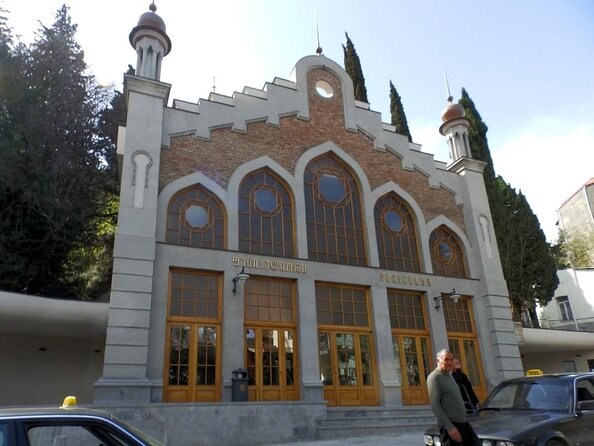
- See Tbilisi from several heights: The tour includes views from the Chronicles of Georgia, Mtatsminda, Mother of Kartli, Narikala Fortress, and the Bridge of Peace.
- Private vehicle between sights: You avoid arranging separate rides across a spread-out city, with an air-conditioned vehicle and driver included.
- A strong church itinerary: Holy Trinity, Metekhi, Sioni, Jvaris Mama, and Anchiskhati show different periods of Georgian religious architecture.
- Food is part of the day: Lunch, Georgian wine tasting, and a restaurant performance of singing and dancing are included.
- Expect active sightseeing: The Old Town section lasts about three hours and includes stairs, hills, and uneven paving.
- One ride costs extra: The Mtatsminda funicular is not included and costs about $7 per person. The aerial tramway to Mother of Kartli is included.
What this nine-hour Tbilisi tour is really like
At $147.50 per person, this is not a bargain walking tour. It makes more sense if you value a private vehicle, an English-speaking guide, a full-day schedule, and a meal with wine and entertainment. If you are traveling with family or a small private party, the price can be easier to justify than paying for several separate taxis and activities.
The tour begins at 9 a.m. and lasts about nine hours. Pickup is offered, though you should confirm the exact pickup arrangement when booking. Since only your group takes part, you can ask for explanations, request a little more time at a favorite stop, or tell the guide if you need a slower pace.
The published score is 4.9 out of 5 from 18 ratings, with 94 percent recommending the experience. One 3 out of 5 comment questioned the guide and overall approach, while the operator stated that it had not operated that particular tour for the customer and offers private tours only. The practical lesson is simple: ask for the guide’s name and confirm the day’s plan before departure. No guide names are provided in the tour details.
A few more things to do in Tbilisi worth a look
- Tbilisi Walking Tour Including Cable Car and Traditional Bakery
★ 5.0 · 1,310 reviews - Tbilisi Walking Tour Including Cable Car and Wine Tasting
★ 5.0 · 16 reviews - Kutaisi:Chiatura Tour with Katskhi Pillar & Cable Car Experience
★ 5.0 · 95 reviews
The Chronicles of Georgia begins the day with scale
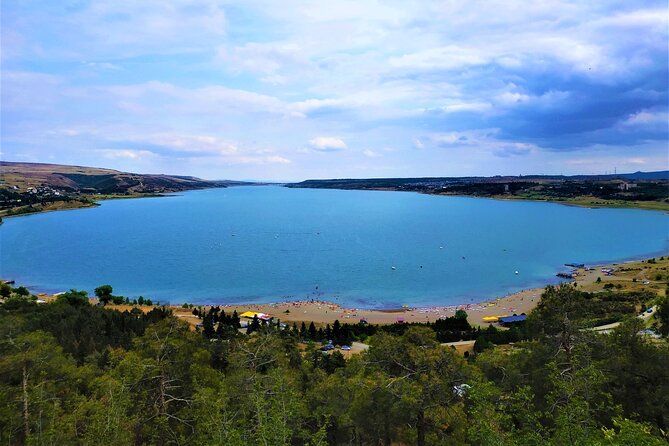
The first stop is the Chronicles of Georgia, a striking memorial made from 16 stone pillars, each about 30 to 35 meters high. The upper sections show Georgian kings, queens, and heroes. The lower sections depict scenes from the life of Christ.
This is a smart opening stop because it gives you a visual introduction to the country before you enter the city center. You can also see the grapevine cross associated with St. Nino, visit a small chapel, take photographs, and look across Tbilisi Sea.
You get about 30 minutes here, with no admission fee. That is enough for photographs and a quick explanation, but not for a long, quiet examination of every carved panel. Bring a camera, but also listen closely to the guide, since the monument’s meaning can be hard to read from the carvings alone.
Holy Trinity Cathedral shows modern Georgian faith
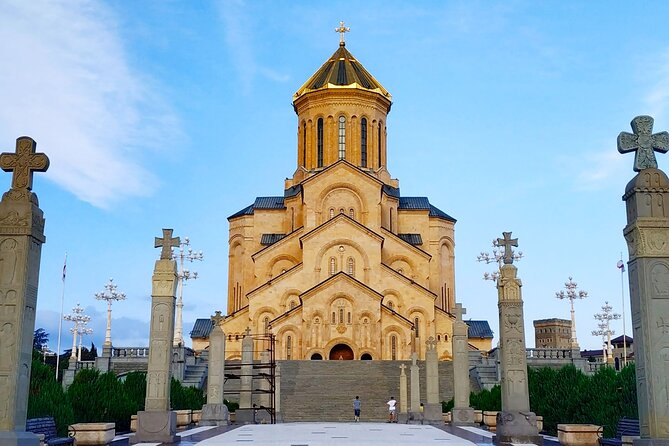
Holy Trinity Cathedral, also called Sameba, is the main cathedral of the Georgian Orthodox Church. It was built between 1995 and 2004 and commemorates 1,500 years of Georgian Orthodox church autocephaly and 2,000 years since the birth of Jesus.
The cathedral is one of the largest Orthodox churches in the world by total area and among the tallest. Its size can feel startling after the compact streets of Old Tbilisi. The tour allows around 40 minutes, free of charge.
Dress matters here and at the other churches. Women need a head scarf and a dress or suitable covering, while men cannot enter in short trousers. Scarves and coverings may be available near church entrances, but it is wiser to dress modestly from the start. This is a religious site, not simply an architectural stop.
Mtatsminda adds a costly but worthwhile viewpoint
The funicular takes you toward Mtatsminda Park, about 770 meters above sea level, the highest point of Tbilisi. The funicular railway runs for 501 meters, with a tunnel angle of roughly 28 to 33 degrees.
The tour allows one hour here, giving you time for the ride and the views over Tbilisi. The ride is not included, and the listed cost is around $7 per person. That extra charge is small compared with the total tour price, but it should not surprise you at the station.
This stop is most useful for getting your bearings. Tbilisi is built around hills and the Kura River, so the high view helps explain the city’s shape. If you dislike paying add-ons or want to keep costs tight, ask whether the viewpoint portion can be shortened. If city views are a priority, the extra fee is easy to defend.
Other tastings around Tbilisi:
- Day Trip to Kakheti Wine Region Including 9 Wine Tastings
★ 5.0 · 2,774 reviews - Kakheti Wine Region: Signagi and Bodbe Tour with 10 Wine Tastings
★ 5.0 · 1,019 reviews - Tbilisi:Mtskheta,Jvari,Bazaar,wine tasting,Chronicles of Georgia
★ 5.0 · 730 reviews - Tbilisi:Evening Walking & Talking Tour with Wine & Boat Ride
★ 5.0 · 572 reviews
Old Town takes three hours, and your shoes matter
The longest part of the day is Old Tbilisi, with about three hours set aside for walking. Tbilisi was founded in the fifth century by Vakhtang I of Iberia and grew at a crossroads between Europe and Asia, close to the Silk Road.
That location shaped the city’s architecture and population. In a single walk, you may see medieval, neoclassical, Beaux Arts, Art Nouveau, Stalin-era, and modern buildings. The city has also been home to several ethnic and religious communities, even though it is now overwhelmingly Eastern Orthodox Christian.
Three hours gives the guide room to connect streets, churches, river views, and monuments rather than rushing through them. You will need comfortable shoes. The route includes stairs, hills, uneven surfaces, and various types of paving.
This is not a good choice if you want a relaxed, vehicle-based sightseeing day. It is a good choice if you like to walk through a city while hearing how its past shaped the streets you see. Pace can matter here, so tell the guide early if anyone in your group needs regular breaks.
Metekhi Church links the cliff to Georgia’s royal past
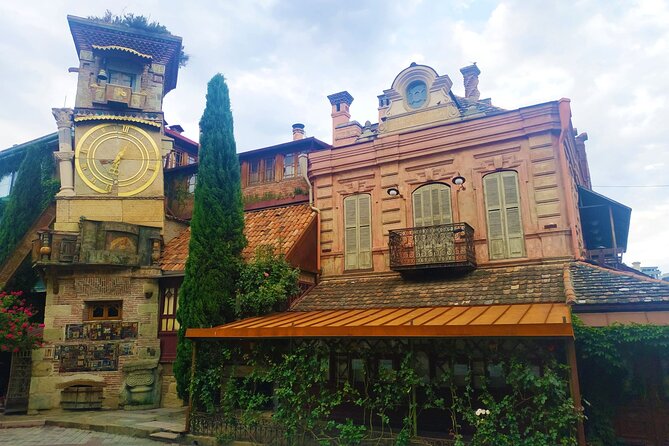
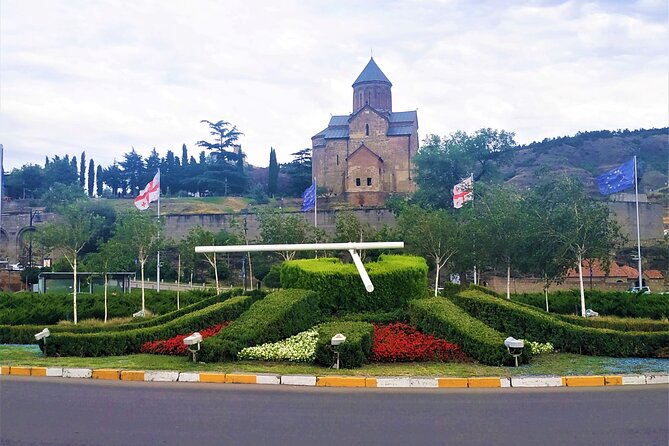
Metekhi Church of Assumption sits above the Kura River and dates in its original form to the reign of King Demetrius II, from 1278 to 1284. It has been damaged and rebuilt several times.
The site also carries a difficult modern history. Under Russian rule, the church lost its religious function and became a soldiers’ base. The nearby citadel was demolished in 1819 and replaced by a jail that remained until the Soviet era. A statue of King Vakhtang Gorgasali was added in 1961.
The tour gives you about 30 minutes here. Look beyond the church interior to the position above the river and the statue of Vakhtang Gorgasali. This is one of the better places to understand how religion, monarchy, military power, and city geography overlap in Tbilisi.
Mother of Kartli and Narikala deliver the big panorama
The aerial tramway carries you toward the Mother of Kartli monument, an aluminum figure erected in 1958 for Tbilisi’s 1,500th anniversary. The 20-meter woman wears national dress and holds a bowl of wine in one hand for friends and a sword in the other for enemies.
That symbol gives the tour’s wine theme a nice visual link. Georgian hospitality is represented by the bowl, but the sword recalls a country that has repeatedly had to defend itself.
The tramway ride is included. After seeing Mother of Kartli, you continue to Narikala Fortress, whose beginnings reach back to the fourth century, when it was a Sasanian citadel called Shuris-tsikhe. King David the Builder expanded it in the 11th and 12th centuries, and the Mongols later gave it the name Narin Qala, meaning Little Fortress.
Most of the surviving walls date from the 16th and 17th centuries. An earthquake damaged the fortress in 1827. You get about 30 minutes for this section, so expect a focused visit rather than a long exploration of every wall.
The views are the main reward. From above, the old roofs, river, bridges, and hills fit together. Surfaces around an old fortress can be uneven, so keep your footing and do not treat the stop as a quick dash for photographs.
The sulfur waterfall adds a small natural break
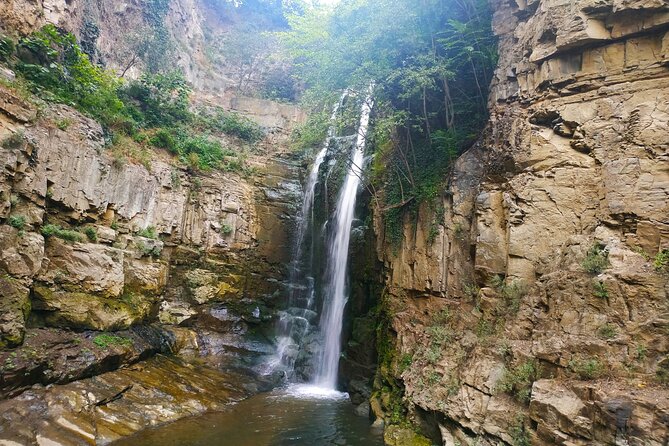
After Narikala, the route descends toward the sulfur bath district and Leghvtakhevi Waterfall. The thermal springs are known for sulfur-rich water at roughly 40 to 50 degrees Celsius. The baths are associated with relief for skin problems, dry scalp, joint pain, digestion problems, and insomnia, though this tour does not include a bathing session.
The waterfall itself flows from the Tbilisi Botanical Garden area. The stop also includes the Love Lock Bridge. You have about 20 minutes, so this is a short walk and photo stop, not a spa visit.
The contrast works well. You move from fortress walls and wide city views to a narrow ravine, warm springs, and running water. The ground may be damp or uneven, making sensible footwear useful again.
Sioni and Jvaris Mama reveal older church layers
Sioni Cathedral takes its name from Mount Zion in Jerusalem. The first church on the site dates from the sixth or seventh century, but invasions led to repeated destruction and rebuilding. The current structure is based on a 13th-century version, with later changes from the 17th through 19th centuries.
King David the Builder rebuilt the cathedral in 1112, and major elements of the present building date from that period. You have about 20 minutes for Sioni and Jvaris Mama together, so the guide will need to keep the explanation focused.
Jvaris Mama means Father of the Cross. The site has links to an older church associated with King Vakhtang Gorgasali and to St. Nino, though the present building dates to the 16th century and was restored in the 1990s. Until 1921, it belonged to the Jerusalem Patriarchate and supported the Jerusalem Cross Church.
These short church visits work best when you are prepared to listen for a few key details rather than inspect every corner. Remember the dress rules, and keep your voice low inside.
Anchiskhati, Leselidze Street, and the clock tower
The route continues along Leselidze Street, with stops connected to the Tamada statue and the Rezo Gabriadze Puppet Theater. Tamada is the Georgian toastmaster, an important figure in the country’s dining and wine traditions.
The theater’s clock tower was added in 2011. On the hour, a window opens and a small angel figure strikes a bell. A screen below shows a cycle of life involving meeting, marriage, childbirth, and funeral. The tour allows around 20 minutes for this area, so check the clock if you want to see the display in action.
Anchiskhati Basilica of St. Mary is the oldest surviving church in Tbilisi, dating to the sixth century. King Dachi originally dedicated it to the Virgin Mary. It took its current name in 1675, when the icon of Ancha was moved to Tbilisi for protection from Ottoman invasion.
The church was built around an icon made by the 12th-century goldsmith Beka Opizari. The icon is now held at the Art Museum of Georgia, but the basilica still gives you a direct connection to early Tbilisi.
The Bridge of Peace leads to lunch and Georgian performance
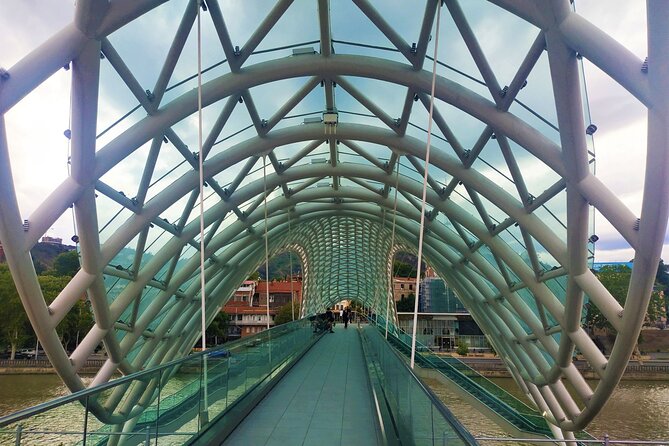
The Bridge of Peace opened in 2010 and crosses the Mtkvari River for 150 meters. Italian architect Michele De Lucchi designed its curving structure, which has a form compared with a marine animal. Rike Park sits at the bridge’s far end.
You get about 10 minutes here, enough for photographs and a quick look at the modern side of Tbilisi. A boat ride on the river is possible for an extra charge, but it is not part of the tour price. With such a short scheduled stop, you should ask the guide before departure if you hope to add it.
The day then moves to a Georgian restaurant and museum for lunch, wine tasting, traditional singing, and dancing. Lunch is included, as are alcoholic drinks and bottled water. Tell the operator about food allergies or dietary restrictions in advance so the meal can be planned.
The restaurant performance gives context to the wine and food rather than treating them as separate extras. Georgia’s dining culture is tied to the toastmaster tradition, and the Tamada stop earlier in the day prepares you for that connection. Alcohol is served only to those of legal drinking age in Georgia, which is 18.
What is included, and what still costs extra
The tour includes:
- Private transportation in an air-conditioned vehicle
- An English-speaking guide
- Bottled water
- Alcoholic beverages
- Lunch
- Wine tasting
- Traditional singing and dancing at the restaurant
- The aerial tramway ride to Mother of Kartli
The Mtatsminda funicular is not included and costs about $7 per person. A boat ride on the Mtkvari is also an optional extra. Admission to the listed churches and the Chronicles of Georgia is free.
The private format is the main value here. You are paying for transport and coordination across a wide route, not just entrance tickets. If you already have a rental car, speak some Georgian or Russian, and prefer choosing your own stops, the price may feel high. If you have one day in Tbilisi and want the logistics handled, it is easier to make the case for booking.
Who should book this Tbilisi day tour?
Book it if you want to cover the city’s major sights in one organized day, especially if you are visiting Tbilisi for the first time. It suits couples, families, and private groups that value a car between distant stops and want lunch and cultural entertainment built into the schedule.
It also suits photographers and view seekers. The Chronicles of Georgia, Mtatsminda, Mother of Kartli, Narikala, Metekhi, and the Bridge of Peace each show a different side of the city.
Think twice if you prefer slow travel. The schedule is full, the Old Town walking section is long, and some churches receive only a short visit. Anyone with mobility concerns should discuss the hills, stairs, fortress paths, and uneven Old Town surfaces before booking.
The tour has free cancellation up to 24 hours before the start time. Changes or cancellations inside that window are not accepted for a refund, and poor weather may lead to a new date or full refund.
Should you book it?
I would book this tour if I had one full day in Tbilisi and wanted a clear first orientation without arranging transport myself. The combination of old churches, fortress views, sulfur district, wine, lunch, and music gives you a useful sense of both the city and Georgian culture.
I would not book it if my main goal were leisurely church study, museums, or an unhurried meal. In that case, choose fewer sights and explore them at your own pace. Before paying, confirm the pickup point, guide details, food restrictions, and the extra funicular charge. Those small checks will help you get the most from a very full day.
FAQ
How long does the Tbilisi tour last?
The experience lasts approximately nine hours and begins at 9 a.m.
Is this a private tour?
Yes. Only your group participates, and private transportation is provided between locations.
Is hotel pickup available?
Pickup is offered, but the exact pickup arrangement should be confirmed when you book.
Is the tour conducted in English?
Yes. English is the offered tour language.
Is lunch included?
Yes. The tour includes a restaurant lunch, and you should provide food allergy or dietary information in advance.
Is wine included?
Yes. Wine tasting and alcoholic beverages are included. The legal drinking age in Georgia is 18.
Does the tour include the funicular ride?
No. The Mtatsminda funicular costs about $7 per person and is paid separately.
What should I wear for the churches?
Women need head scarves and dresses or suitable coverings, while men cannot enter in short trousers. Scarves and coverings may be available near church entrances. Comfortable shoes are also recommended for the Old Town’s stairs and uneven terrain.
More full-day tours in Tbilisi
- Kutaisi Canyons and Caves from Tbilisi Full Day Tour
★ 5.0 · 448 reviews - Kazbegi and Gudauri Full Day Private Tour from Tbilisi
★ 5.0 · 447 reviews - Full Day Private Wine Tour in Kakheti Region with Lunch and 3 Wine Tastings
★ 5.0 · 207 reviews - Kazbegi Full-Day Private Tour with Scenic Stops from Tbilisi
★ 5.0 · 125 reviews
More Food & Drink in Tbilisi
- Old Tbilisi Tour: Private Walking Tour With Wine Tasting
★ 5.0 · 273 reviews - Private Tbilisi Food Tour: 9 Tastings Walk in Bohemian District
★ 5.0 · 227 reviews - Tbilisi Food Tour in a Local Family
★ 5.0 · 113 reviews - Private Wine Tasting in Prince Karalashvili Wine Cellar. Tbilisi
★ 5.0 · 63 reviews
Just added in Tbilisi
- 8-Day Trekking Group Tour in Svaneti★ 5.0 · 21 reviews
- Private five days tour to Svaneti-Mestia, Ushguli, Becho,Chalaadi★ 5.0 · 21 reviews
- Join a Local for a Market Tour, Cooking Class and Meal in her Tbilisi Home★ 5.0 · 15 reviews
- Chiatura and Katskhi Pillar One Day Urbex Tour★ 5.0 · 14 reviews
- Soviet Story – Private day trip to Chiatura, Stalin’s museum and Katskhi pillar★ 4.5 · 15 reviews
- Tbilisi Walking Tour Including Cable Car and Wine Tasting★ 5.0 · 16 reviews
- Dashbashi Canyon, Glass Bridge, Bicycle Zip Line, Swing, Private Full Day Tour★ 5.0 · 25 reviews
- Mtskheta – Gori – Uplistsikhe caves • Private tour★ 5.0 · 24 reviews
Wine Tours, compared.
Day Trip to Kakheti Wine Region Including 9 Wine Tastings
Read our review →
Kakheti Wine Region: Signagi and Bodbe Tour with 10 Wine Tastings
Read our review →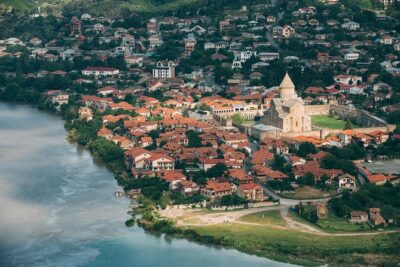
Mtskheta,Jvari,Bazaar,wine tasting,Chronicles of Georgia
Read our review →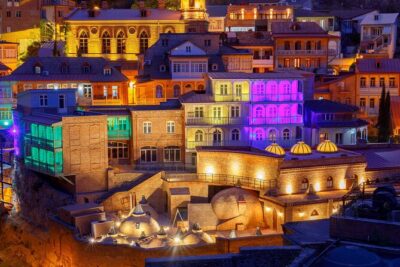
Evening Walking & Talking Tour with Wine & Boat Ride
Read our review →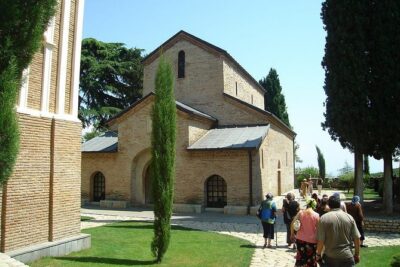
Kakheti;City of Love Sighnaghi, Bodbe. KTW. Wine House Group tour
Read our review →
Bodbe, Sighnaghi, Telavi Wine Tour from Tbilisi
Read our review →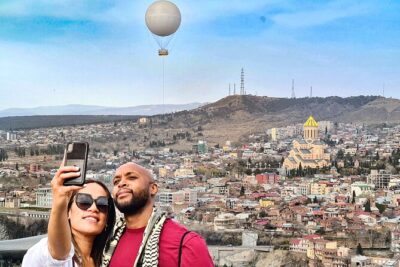
Old Tbilisi Highlights walking tour with wine & 10 tastings
Read our review →
Old Tbilisi Tour: Private Walking Tour With Wine Tasting
Read our review →Browse the lists this tour appears in