

Reviewed · WINE TOURS
Old Tbilisi Tour: Private Walking Tour With Wine Tasting
Old Tbilisi is best understood on foot, but this tour gives you a useful shortcut to the city’s best viewpoint: the cable car up to Narikala Fortress. From there, you walk downhill through old lanes, sulfur baths, a waterfall gorge, churches, parks, and the modern Bridge of Peace before settling in with Georgian wine.
I like the private format, since your guide can adjust the pace and explain what interests you most. I also like the mix of grand history and ordinary city life, from the fourth-century fortress to the warm sulfur springs of Abanotubani. The main consideration is the walking: steep streets, uneven surfaces, and stairs mean you should have a moderate level of fitness.
At a glance: what makes this tour useful
- Cable car access to Narikala Fortress: You avoid beginning with a long uphill climb and get wide views over Tbilisi.
- A downhill route through Old Tbilisi: The walk links major sights without wasting time crossing the city.
- Private attention from your own guide: Luka, Lela, Mariam, Mirian, and other guides can adjust the pace and focus.
- A taste of Georgian wine: The tasting adds an important part of Georgian culture to a history walk.
- A compact introduction to Tbilisi: In roughly 2.5 hours, you cover churches, fortifications, baths, a waterfall, a statue, and modern architecture.
- Good first-day orientation: The walk gives you restaurant suggestions, neighborhood bearings, and an overview of central Tbilisi.
Why the cable car makes a difference
The tour starts at Metekhi Church of the Nativity of the Mother of God, then uses a cable car ticket to reach the upper part of the route. That choice matters. Tbilisi’s old center sits around steep hills and the Mtkvari River, so beginning high and walking down is more comfortable than tackling the same route uphill.
At the top, you reach the area around Narikala Fortress. The cable car is also part of the sightseeing, not just transport. You get a quick look across the river and over the roofs of the old city before stepping into the fortress grounds.
Timing can affect the experience. One guide recommended around 7:30 p.m. in summer for the cooler air and late-day views. Another practical suggestion from the tour experience is to choose morning or evening during hot weather. The tour requires good weather, so a rainy or stormy forecast can lead to a new date or a full refund.
Other tastings around Tbilisi:
- Day Trip to Kakheti Wine Region Including 9 Wine Tastings
★ 5.0 · 2,774 reviews - Kakheti Wine Region: Signagi and Bodbe Tour with 10 Wine Tastings
★ 5.0 · 1,019 reviews - Tbilisi:Mtskheta,Jvari,Bazaar,wine tasting,Chronicles of Georgia
★ 5.0 · 730 reviews
Narikala Fortress and the two faces of Tbilisi
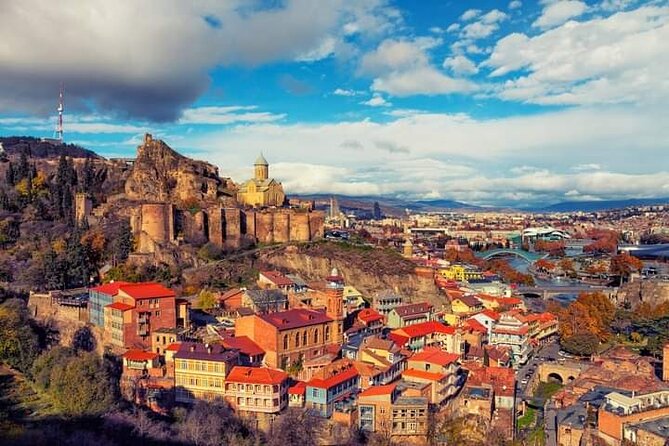
Narikala is the historical anchor of the tour. The first structure here dates to the fourth century, when it was a Sasanian citadel called Shuris-tsikhe, or Invidious Fort. The Umayyads expanded it in the seventh century, and King David the Builder added to it later. The Mongols gave it the name Narin Qala, meaning Little Fortress.
Most of what you see today comes from the sixteenth and seventeenth centuries. An earthquake damaged parts of the complex in 1827, and some sections were later demolished. You can walk around the remaining walls and take in the rough stonework rather than viewing the fortress from below.
The setting is the real prize. From one side of the walls, you see Tbilisi spread across the river valley, with roads, rooftops, churches, and newer buildings. Turn the other way and the view becomes quiet and green, looking toward the Botanical Garden. That sharp change is one of the best visual lessons in the city: Tbilisi can feel urban and almost rural within a few steps.
Your guide can add the political and religious context that the stones alone do not provide. Guides such as Luka and Mirian are often singled out for explaining facts without turning the walk into a lecture. That balance is especially useful here, since Narikala has many layers of history but only limited surviving structures.
Allow about 20 minutes at the fortress. Bring shoes with a firm sole. The exact route around the walls may involve uneven ground, and this is not a polished museum-style attraction.
Kartlis Deda and the Georgian welcome
A short walk brings you to Kartlis Deda, the Mother of Georgia statue. The twenty-meter aluminum figure was erected on Sololaki Hill in 1958, the year Tbilisi marked its 1,500th anniversary. Georgian sculptor Elguja Amashukeli designed the woman in national dress.
Her two objects explain a familiar idea about Georgian character. In her left hand she holds a bowl of wine for friends. In her right she carries a sword for enemies. It is a simple image, but it makes a good bridge between the fortress above and the city below.
The stop lasts about ten minutes and does not require a separate admission ticket. You probably will not spend long here, but the statue gives your guide a chance to explain Georgian hospitality, national identity, and the symbolic role of wine before the tasting later in the walk.
Abanotubani: where Tbilisi gets its name
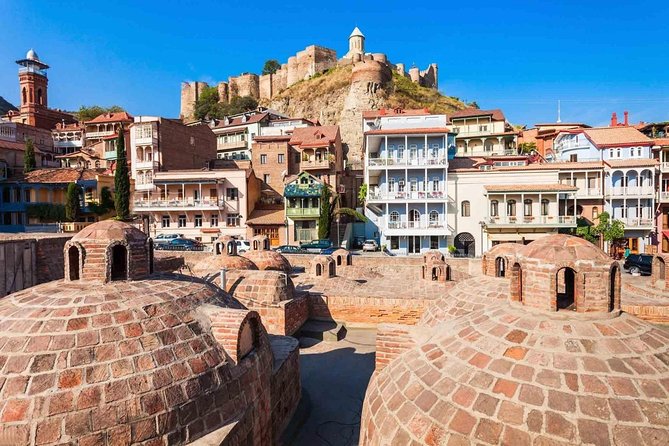
From the hill, the route heads down toward Abanotubani, the sulfur-bath district. According to local tradition, this area helped lead to the founding of Tbilisi in the fifth century. The name is tied to the warm springs, and sulfur water still rises naturally from the ground here.
The springs supply about 3 million liters of water each day, with an average temperature of 47 degrees Celsius. You will see the distinctive bathhouse domes and hear the story of how hot water shaped the city’s beginnings.
This is one of the places where a local guide adds real value. Without explanation, the bath district can look like a photogenic collection of domes. With context, it becomes a key part of Tbilisi’s name, growth, and daily life.
The walk downhill is easier than the climb would be, but the route can still be hard on knees. The private setup helps if you need a short pause or want more time for photographs. Guides have adjusted schedules when conditions changed, including when the cable car was closed, so flexibility is one of the useful features here.
A few more things to do in Tbilisi worth a look
- Private Tbilisi Food Tour: 9 Tastings Walk in Bohemian District
★ 5.0 · 227 reviews - Tbilisi Food Tour in a Local Family
★ 5.0 · 113 reviews - Private Wine Tasting in Prince Karalashvili Wine Cellar. Tbilisi
★ 5.0 · 63 reviews - Private Tour From Tbilisi to Kakheti Sighnaghi with Wine Tasting
★ 5.0 · 35 reviews
Leghvtakhevi Gorge and the city waterfall
The next stop is Leghvtakhevi Gorge, a narrow natural break in the middle of the capital. A short path and a bridge lead to a small waterfall tucked inside the old city.
The waterfall is not enormous, so you should set your expectations correctly. Its appeal is the contrast: within minutes of the fortress, bathhouses, and busy streets, you are beside running water and shaded rock. In summer, the cooler air makes this a welcome pause.
The stop lasts around ten minutes. The path is accessible to visitors, but wet surfaces and uneven sections can still require care. If you are taking the tour in the hottest part of the day, this may be one of the most comfortable parts of the route.
Jan Shardeni Street and Sioni Cathedral

After the gorge, you continue toward Jan Shardeni Street, often called Chardin Street. It is named for Jean Chardin, an eighteenth-century French traveler who visited Georgia. Today, the street is known for restaurants, bars, and nightlife that can continue late into the night.
The guide can help you read the street in two ways. You see the polished social side of central Tbilisi, but you are also still walking through one of the city’s old districts. This makes the stop useful for deciding where to return later for food or an evening drink.
Sioni Cathedral follows, with about ten minutes inside or around the church. The first church on this site was built in the fifth century by order of Vakhtang Gorgasali. The present building dates mainly to the seventeenth century and contains the original fourth-century cross associated with St. Nino.
Dress and behavior should be respectful at the cathedral. Religious sites are active places of worship, not simply photo stops. Your guide can explain the church’s importance while helping you understand what you are seeing.
The Bridge of Peace and Rike Park
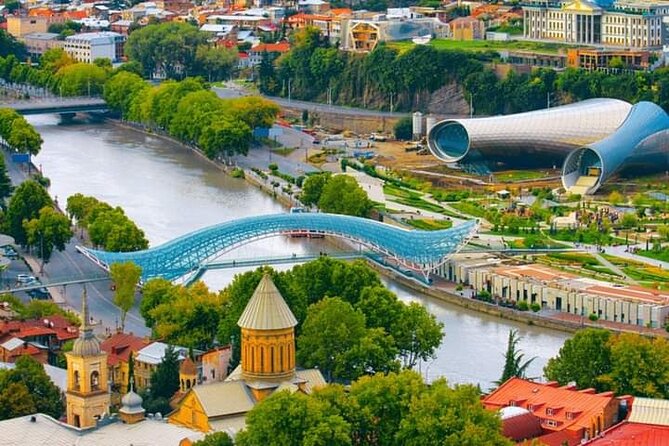
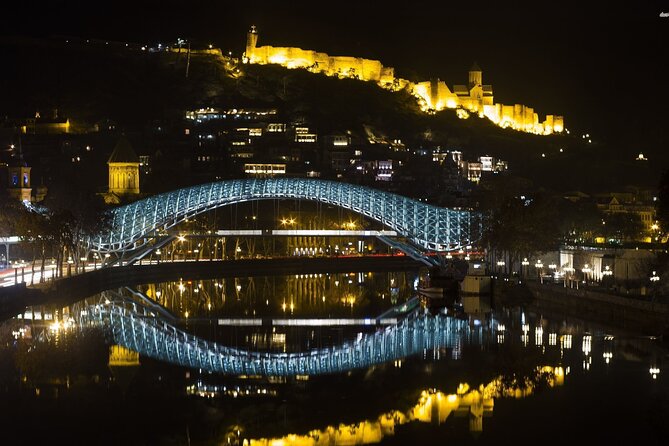
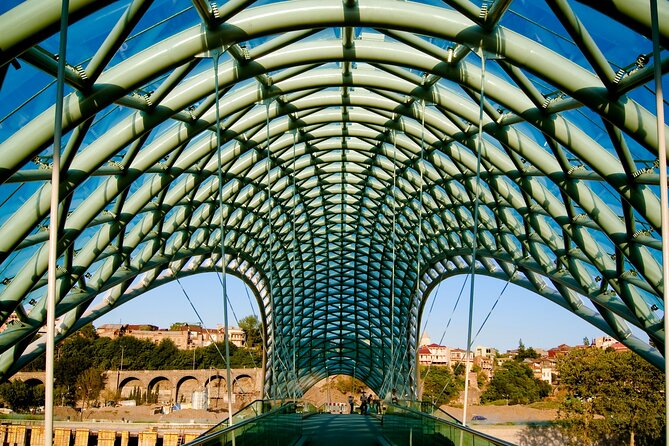
The Bridge of Peace offers a sharp change in mood and design. Opened in 2010, the glass-and-steel pedestrian bridge stretches 156 meters across the Mtkvari River and uses about 10,000 lamps.
Some visitors like its bold modern shape; others prefer Tbilisi’s older stone buildings. Either way, it is an important part of the city’s present-day identity. From the bridge, you can look back toward the old quarters and forward toward newer public spaces.
The route continues through Rike Park toward Metekhi Cathedral. This section is relatively easy compared with the hill around Narikala, and it gives you time to absorb the contrast between medieval-looking streets and recent urban design.
Metekhi Cathedral and the final city view
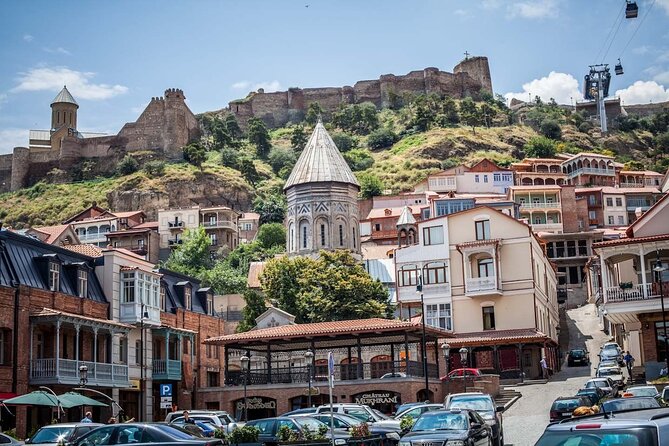
The last major stop is Metekhi Cathedral of St. Mary, on the left bank of the Mtkvari. The church is linked by tradition to the remains of St. Shushanik, and a statue of Vakhtang Gorgasali stands in the courtyard.
The meeting point is at Metekhi Church, and the activity ends back at that same point. Starting and finishing in this area makes the tour convenient for connecting with other plans in central Tbilisi, though you should allow a little time after the official finish if you want to linger.
Metekhi is a fitting close because it brings together several themes from the walk: the river, the old capital, religious tradition, royal history, and the steep terrain that shaped Tbilisi.
Georgian wine as part of the history lesson
Wine tasting is included, and it is more than a quick beverage stop. Georgia is proud of its wine culture, and the tasting gives you a practical way to connect the country’s history with something you can smell and taste.
The exact tasting format can vary. Some participants have also sampled chacha, the local grape spirit, and one account described eight or nine wine samples followed by a chimney cake. That should not be treated as a fixed promise, but it gives you an idea of the relaxed, social character of the finish.
The wine stop can also be useful after the tour. One guide brought a group to a place with a rooftop patio, and they returned later to buy a bottle. Your guide may also suggest Georgian restaurants and other places to visit, which is particularly helpful if this is your first day in Tbilisi.
If you do not drink alcohol, confirm the available alternatives when booking or with your guide. A previous tour included juice as well as wine, but the standard inclusions specifically list wine tasting, not a guaranteed nonalcoholic option.
The private format and the guides
The tour is private, so only your group takes part. That is the main reason the $39 price can be worthwhile. You are not paying only for a list of monuments. You are paying for a guide who can adjust the pace, answer your questions, add extra stops when practical, and change the order if conditions require it.
Luka is often praised for a friendly, flexible style and for suggesting reasonably priced Georgian food. Lela is known for warm storytelling and for sharing extra places beyond the basic route. Mariam has offered useful timing advice for the cable car, while Mirian is particularly good at presenting a lot of information in a relaxed way.
You cannot assume you will receive a particular guide unless the operator confirms it. Still, the repeated pattern is clear: the strongest part of this experience is the human explanation of the city. The best guide for you will be one who matches your interests, whether you want ancient history, food, current events, photography, or a light overview.
How much time, effort, and money to allow
The advertised duration is about two to three hours, with many tours taking roughly 2.5 hours. That is enough time to cover the main stops, but not enough for long visits inside every church or fortress. You are getting a well-paced introduction, not a full archaeological study of Tbilisi.
At $39 per person, the price is reasonable for a private walk that includes a cable car ticket and wine tasting. It becomes better value for two or more people sharing the private guide, especially if you care about asking questions or setting your own speed. Group discounts may also be available.
Gratuities are not included. Hotel pickup and drop-off are also not included, so you need to reach Metekhi Church independently. The meeting point is near public transportation, and confirmation arrives when you book.
Wear comfortable shoes, bring water, and consider the weather before choosing your time. The walk is not described as wheelchair-friendly, and the moderate fitness requirement is worth taking seriously because of the hills, walking surfaces, and fortress terrain. Service animals are allowed.
Who should book this Old Tbilisi walk
I would choose this tour if you have only a short time in Tbilisi and want a clear introduction to the central sights. It also works well early in a trip, since the route helps you understand where the old city, river, baths, nightlife streets, and main viewpoints fit together.
It suits couples, families with older children, and small groups of coworkers or friends who want private conversation rather than a large shared group. Food and wine fans will get extra value from the tasting and restaurant suggestions.
I would think twice if you want a slow, highly detailed visit to each monument, or if steep walking is difficult for you. You may also prefer a dedicated wine tour if Georgian wine is your main interest. Here, wine is an enjoyable cultural finish to a broader city walk.
Should you book it?
Book this tour if you want a compact, private introduction to Tbilisi that combines major sights with local explanation. The cable car saves energy, the downhill route covers a lot of ground, and the wine tasting gives the experience a distinctly Georgian finish.
Choose a morning or evening departure in summer, and ask about guide availability if you have a strong preference for Luka, Lela, Mariam, or Mirian. For $39 per person, the combination of a private guide, cable car ticket, and tasting makes this a solid first look at Old Tbilisi, provided you are comfortable walking hills and uneven streets.
FAQ
How long does the Old Tbilisi tour last?
The tour lasts approximately two to three hours. Many visitors complete it in about 2.5 hours.
What is the meeting point?
The tour begins at Metekhi Church of the Nativity of the Mother of God on Metekhi Street in Tbilisi.
Where does the tour end?
The activity ends back at the meeting point near Metekhi Church.
Is the tour private?
Yes. Only your group participates in the activity.
Is the cable car ticket included?
Yes. A cable car ticket is included in the tour price.
Is wine tasting included?
Yes. Wine tasting is included. Some tour experiences have also included chacha or juice, but those should not be treated as guaranteed inclusions.
Does the tour include hotel pickup?
No. Hotel pickup and drop-off are not included.
How physically demanding is the walk?
A moderate level of physical fitness is recommended. The route includes walking through Old Tbilisi, hills, fortress surfaces, and uneven streets.
What happens if the weather is poor?
The experience requires good weather. If it is canceled because of poor weather, you can choose a different date or receive a full refund. You can also cancel for a full refund if you do so at least 24 hours before the start time.
More Walking Tours in Tbilisi
- Tbilisi Walking Tour Including Cable Car and Traditional Bakery
★ 5.0 · 1,310 reviews - Tbilisi:Evening Walking & Talking Tour with Wine & Boat Ride
★ 5.0 · 572 reviews - Old Tbilisi Highlights walking tour with wine & 10 tastings
★ 5.0 · 276 reviews - Tbilisi Old Town Walking Tour with a Local Guide
★ 5.0 · 168 reviews
Just added in Tbilisi
- 8-Day Trekking Group Tour in Svaneti★ 5.0 · 21 reviews
- Private five days tour to Svaneti-Mestia, Ushguli, Becho,Chalaadi★ 5.0 · 21 reviews
- Join a Local for a Market Tour, Cooking Class and Meal in her Tbilisi Home★ 5.0 · 15 reviews
- Chiatura and Katskhi Pillar One Day Urbex Tour★ 5.0 · 14 reviews
- Soviet Story – Private day trip to Chiatura, Stalin’s museum and Katskhi pillar★ 4.5 · 15 reviews
- Full Day Tbilisi City Tour with Wine Tasting & Cable Car Ride★ 5.0 · 18 reviews
- Tbilisi Walking Tour Including Cable Car and Wine Tasting★ 5.0 · 16 reviews
- Mtskheta, Ananuri, Gudauri and Kazbegi Full Day Tour from Tbilisi★ 4.5 · 25 reviews
Wine Tours, compared.
Day Trip to Kakheti Wine Region Including 9 Wine Tastings
Read our review →
Kakheti Wine Region: Signagi and Bodbe Tour with 10 Wine Tastings
Read our review →
Mtskheta,Jvari,Bazaar,wine tasting,Chronicles of Georgia
Read our review →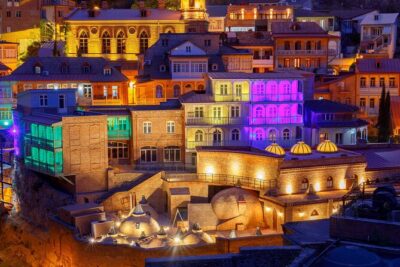
Evening Walking & Talking Tour with Wine & Boat Ride
Read our review →
Kakheti;City of Love Sighnaghi, Bodbe. KTW. Wine House Group tour
Read our review →
Bodbe, Sighnaghi, Telavi Wine Tour from Tbilisi
Read our review →
Old Tbilisi Highlights walking tour with wine & 10 tastings
Read our review →
Browse the lists this tour appears in