
Reviewed · WALKING TOURS
Tbilisi Explorer: Essential Walking Tour for First-Timers
Tbilisi reveals itself in layers on this compact private walk: imperial squares, sixth-century churches, a modern glass bridge, sulphur water, old lanes, and hilltop views tied together by a local guide. I like the way the route covers both old and modern Tbilisi, rather than leaving you with only postcard streets.
I also like the private format. Guides such as Tamar, Koba, Sofi, and Aleksi have adjusted the pace, helped with souvenirs, answered food questions, and made the walk work for families. The main drawback is the ambitious route: at 90 minutes to two hours, you will get a useful first look, not a slow examination of every site.
Key points to know before booking
- A compact city overview: You see Freedom Square, the Old Town, churches, markets, parks, monuments, and the river corridor in one outing.
- A private guide for your group: The pace and emphasis can be adjusted, which is useful with children or a tight schedule.
- One cable-car ride included: The route links Rike Park with the hilltop area near Narikala and Kartlis Deda.
- A strong first-day choice: The walk gives you names, directions, and landmarks that make later exploring easier.
- Expect hills and uneven walking: Moderate fitness is required, and the route includes the climb by cable car to the upper city.
- Dress for churches and religious sites: Knees and shoulders must be covered for both men and women.
Why this route works for a first look at Tbilisi
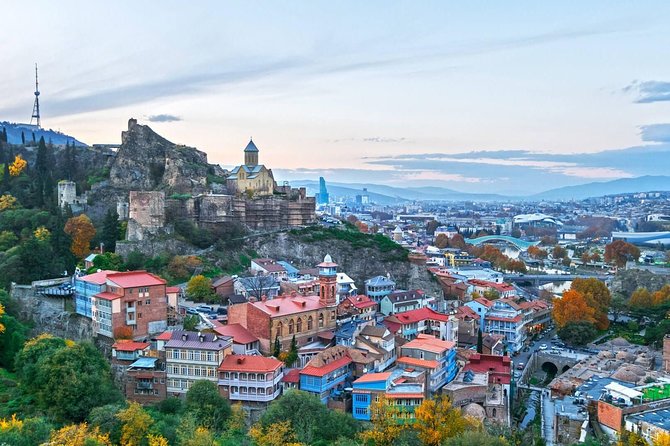
Tbilisi can feel confusing at first. The Mtkvari River cuts through the center, the Old Town climbs into hills, and several major sights sit close together but are not obvious from street level. This tour gives you a basic map in your head.
You begin at Freedom Square, then move toward the oldest parts of the city. Along the way, the route shifts from grand civic space to narrow historic streets, then across the Bridge of Peace and up toward the hilltop statue of Kartlis Deda. The return through Rike Park and the river area gives you a different view of the same city.
The $41 price is sensible if you value a private guide and want to cover a lot in a short time. A solo booking pays for personal attention, while a small group can make the cost easier to justify. The cable-car ride is included one way, though you should confirm exactly how the operator handles the ticket at booking because the itinerary also lists the tramway admission as not included.
The timing needs a little interpretation. The route lists 19 stops, including several 15-minute visits and an hour in the Old Town, yet the advertised duration is only 90 minutes to two hours. Treat the stop lengths as a suggested outline rather than a promise. Your guide will need to keep moving, and some monuments will be viewed from outside.
A few more things to do in Tbilisi worth a look
- Tbilisi Walking Tour Including Cable Car and Traditional Bakery
★ 5.0 · 1,310 reviews - Tbilisi:Evening Walking & Talking Tour with Wine & Boat Ride
★ 5.0 · 572 reviews - Old Tbilisi Highlights walking tour with wine & 10 tastings
★ 5.0 · 276 reviews
Freedom Square and the first city lesson
Freedom Square is a useful starting point because it sits at the eastern end of Rustaveli Avenue, in the center of Tbilisi. It has carried several names over the centuries, including Erivansky Square during the Russian imperial period, and Beria and Lenin Square under Soviet rule.
That changing name gives your guide an easy opening to explain how Georgia’s capital has passed through different political eras. You will not spend long here, but the square helps you understand Tbilisi as a city shaped by empire, revolution, Soviet rule, and modern independence.
From there, the route heads toward the remains of the old city wall. The ruins are not a grand fortified complex, but they help you picture the boundaries of earlier Tbilisi. I like this kind of stop because it gives physical meaning to the phrase Old Town, which can otherwise become a label without much content.
Anchiskhati Basilica and the old religious core
Anchiskhati Basilica of St Mary is the oldest surviving church in Tbilisi, dating from the sixth century. It belongs to the Georgian Orthodox Church and is one of the most important early buildings on the route.
Plan on a short visit rather than a long architectural study. The value is in seeing an active place of worship that predates many of the city’s later monuments. If the interior is open, keep your voice low and follow the guide’s instructions.
Dress carefully from the start. Shorts and sleeveless tops are not accepted at religious sites, and both men and women must cover their knees and shoulders. You may be refused entry if you ignore this rule, so modest clothing is a practical part of preparing for the walk, not a minor detail.
The Bridge of Peace and Tbilisi’s modern face
The Bridge of Peace opened in 2010 over the Mtkvari, also called the Kura River. Its glass and steel design looks very different from the stone churches and older lanes nearby.
This contrast is one of the best parts of the outing. In a few minutes, you move from an early medieval basilica to a recent public landmark. The bridge also gives you a clear sense of the river corridor and links the Old Town with Rike Park.
Your guide can help you read the city in both directions: old neighborhoods behind you, newer public spaces ahead. The stop is short, so use it for orientation and photographs rather than expecting a detailed architectural lecture.
Same base, a different sort of day:
- Day Trip to Kakheti Wine Region Including 9 Wine Tastings
★ 5.0 · 2,774 reviews - Highlights of Caucasus Mountains-Jinvali,Ananuri,Gudauri,Kazbegi(Group tour)
★ 5.0 · 2,682 reviews - Day Trip to Kazbegi and Gudauri
★ 5.0 · 2,009 reviews - Day Trip to Mtskheta Gori and Uplistsikhe
★ 5.0 · 1,801 reviews
Sayat-Nova, Gabriadze, and the arts of the city
Near the northern wall of St Kevork Armenian Church, you will find the monument to Sayat-Nova, an Armenian poet and musician. His story reflects the mixed cultural character of Tbilisi. He was killed on the church doorstep during the 1795 attack by Shah Aga Mohammad Khan Qajar and is buried there.
The stop takes only about 15 minutes, but it adds a human story to the route. Tbilisi is not only a collection of Georgian monuments. Armenian, Persian, Russian, and other influences have also shaped the capital.
The Rezo Gabriadze Marionette Theater is another small but memorable stop. Opened in 1981, it became an important part of Tbilisi’s cultural life. You may see the building as part of the walk rather than attend a performance, so check separately if a show is a priority.
Nearby, the monument to filmmaker Sergei Parajanov points to another side of the city’s artistic identity. Parajanov directed films such as The Colour of Pomegranates and Shadows of Forgotten Ancestors, using a highly poetic visual style. The monument is a quick stop, but it gives your guide a chance to explain why this filmmaker remains important across the Caucasus.
Old Town, Shardeni Street, and Meidan Bazaar

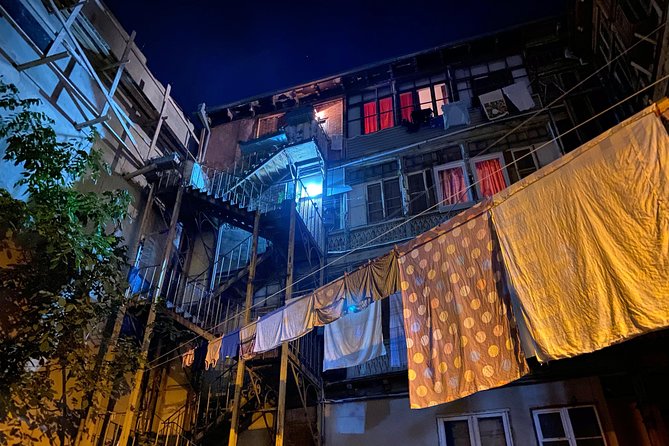
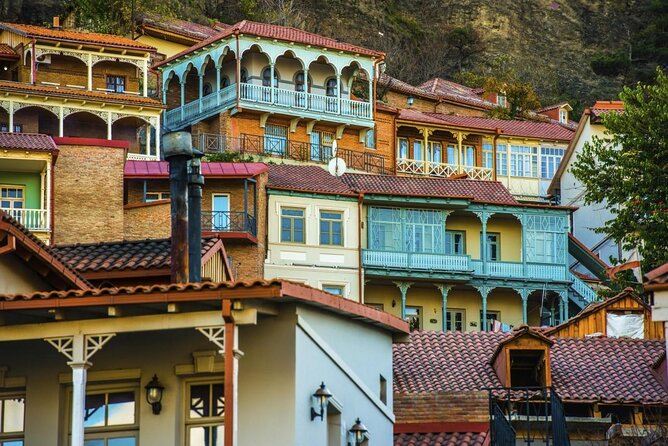
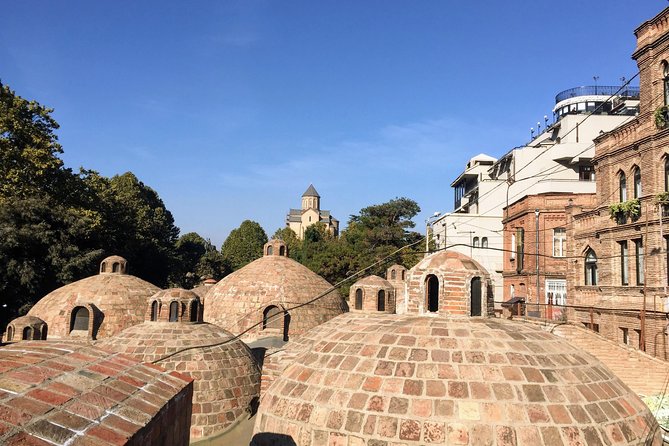
The Old Town is the heart of the experience. This is where you will see old buildings, restaurants, theaters, narrow streets, and the uneven rhythm of central Tbilisi. The route allows about an hour here, which is the longest single portion of the outing.
Do not expect every lane to be quiet or untouched. The Old Town is a working part of the capital, with places to eat, shops, traffic at the edges, and plenty of people moving through it. That is part of its appeal. You are seeing a living district, not an open-air museum.
Jan Shardeni Street is one of the best-known pedestrian streets in this area. It is attractive and convenient, though it can feel more polished and commercial than the smaller lanes nearby. The 30-minute stop gives you time to look around, ask your guide about restaurants, or note places to return to later.
Meidan Bazaar is useful if you want souvenirs but do not have time to search widely. The covered market offers a simple place to browse local goods. I would use your guide’s advice here, especially if you are unsure about prices or the difference between a useful keepsake and a generic tourist purchase.
One guide, Aleksi, was especially helpful with sellers and price negotiations, according to the experience details. That kind of assistance can matter when you are new to the country and do not speak Georgian. It should not be assumed that every guide will negotiate every purchase, but it is worth asking for help.
The cable car, Kartlis Deda, and the best city view
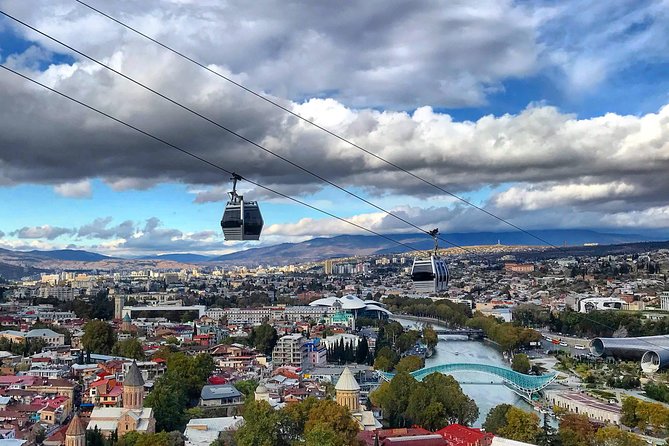
The aerial tramway links Rike Park with Narikala, the fortress above the Old Town. It opened in 2012 and turns a steep climb into a quick ride. One direction is included, which makes the cable car a practical part of the route rather than an optional extra.
The upper section brings you toward Kartlis Deda, the large aluminum figure of a woman in Georgian national dress. The 20-meter statue was created by sculptor Elguja Amashukeli and erected in 1958, when Tbilisi marked its 1,500th anniversary.
Kartlis Deda carries a sword in one hand and a bowl of wine in the other, a familiar symbol of Georgia’s welcome to friends and defense against enemies. The statue is more than a photo stop. From this hill, you can see how the river, Old Town, parks, and newer districts fit together.
The cable car also means the route is not a flat stroll. You should be comfortable walking on slopes and uneven surfaces. The tour description calls for moderate physical fitness, and that is fair even though the tramway removes the hardest uphill section.
Sioni Cathedral, Jumah Mosque, and shared city space
Sioni Cathedral of the Dormition is a Georgian Orthodox cathedral named after Mount Zion in Jerusalem. The building connects Tbilisi with an old Georgian custom of naming churches after places in the Holy Land.
Jumah Mosque offers a different religious perspective. It sits in the center of the Old Town and is notable for allowing Shia and Sunni Muslims to pray together. It is open to people of all religions and beliefs, but respectful clothing still matters.
Seeing these sites on the same walking route is one of the experience’s strongest features. You get more than a list of monuments. You see how several faith traditions occupy the same compact city center. The time at each site is brief, so ask your guide questions if this part interests you.
Rike Park, the Toaster, and Tbilisi’s founding legend
Rike Park sits beside the Mtkvari and is a popular public recreation area. It gives you room to pause after the narrow streets of the Old Town and provides another view toward the Bridge of Peace and the hills.
The nearby Toaster sculpture shows a man holding a horn, modeled on an ancient Colchian statuette and affectionately linked with the Georgian tamada, or toastmaster. If you plan to share a meal in Georgia, the tamada tradition will help explain why toasts carry such weight in local dining culture.
The Fountain Falcon and Pheasant represents the legend of Tbilisi’s founding in the fifth century by King Vakhtang Gorgasali. According to the story, the king’s falcon discovered the area’s hot springs while hunting. The sculpture is a fast stop, but it connects the modern capital with one of its best-known origin stories.
Sulphur waterfall and Metekhi Cathedral
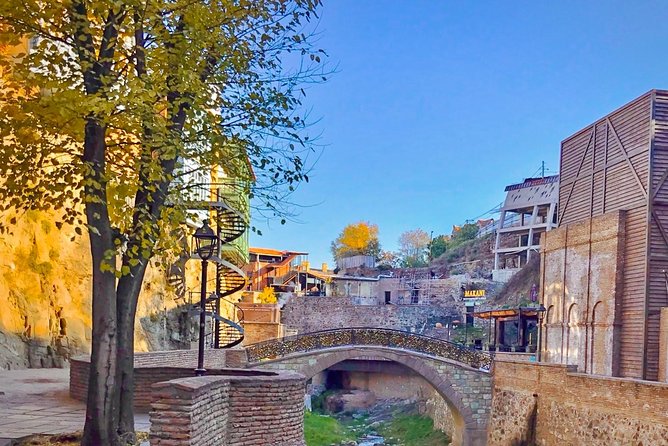
The Dzveli Tbilisi sulphur waterfall is a delightful surprise because it sits in the middle of the city. You are not leaving town for a nature stop. You are walking through the historic center and suddenly encountering flowing water tied to the city’s famous hot springs.
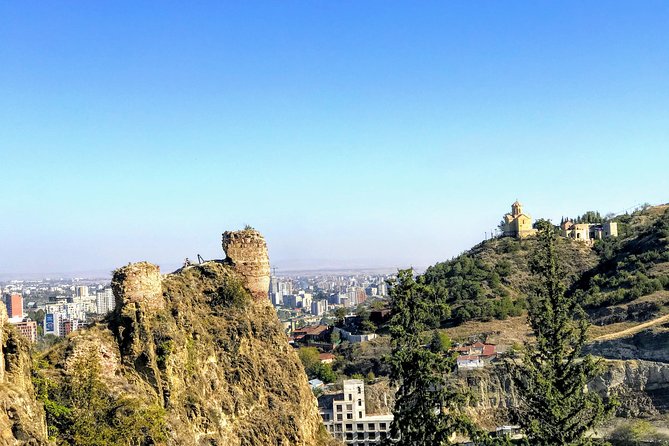
Metekhi Cathedral finishes the route near the rocky bank of the Mtkvari. The church dates to the 12th century and occupies a strong position above the river. It is one of the city’s most recognizable historic views, especially when seen from across the water.
The route is scheduled to end back at the meeting point, but the supplied details describe the final sights in the Metekhi and river area. Ask your guide to confirm the exact finish point on the day, particularly if you have a restaurant booking or transport waiting.
Guide style and the private-tour advantage
The guide can make or break a fast city walk. The experience has featured guides including Gio, Jonah, Koba, Aleksi, Tamar, and Sofi, though you should not assume a particular person will lead your booking unless the operator confirms it.
The strongest pattern is personal attention. Gio adapted to a fast walking pace, Jonah shaped the route around a family’s schedule, and Aleksi helped a parent traveling with a toddler stay comfortable. Tamar has also added food discussion and, in one case, wine tasting at the end.
That flexibility is the main reason to choose this over a large group walk. You can ask to spend more time on churches, food, Soviet-era history, shopping, or views. You can also tell the guide if you need a slower pace.
The tradeoff is that a private tour may feel expensive for a solo visitor compared with a public group walk. At $41 per person, though, the price becomes more attractive when two or more people share the booking and want a guide focused only on them.
Timing, clothing, and cancellation details
The meeting point is 2 Freedom Square in Tbilisi. Hotel pickup is not included, so arrange your own way to the start. The area is near public transportation.
Confirmation is provided when you book, and service animals are allowed. The experience requires good weather. You can cancel for a full refund up to 24 hours before the start time, but changes or cancellations inside that window are not accepted. If poor weather cancels the tour, you will be offered another date or a full refund.
Wear shoes suited to city walking and clothing that covers your knees and shoulders. The religious stops are not optional decoration on the route, and improper clothing can prevent entry.
Who should book this Tbilisi walk?
I would choose this tour for a first day in Tbilisi, especially if you have only a few hours or want a guide to set the city in place. It suits couples, families, solo visitors, and small private groups that prefer conversation over a fixed lecture.
It is also a good match for people who want practical help. Sofi has helped with souvenirs and questions, Tamar has discussed food and wine, and Aleksi has made the route easier for a family with a toddler.
I would not choose it if you want long museum visits, a slow photography walk, or detailed time inside every church. The route covers a great deal, and the short duration means you will pass some places quickly.
Should you book it?
Book it if you want a well-rounded first orientation to Tbilisi, personal attention, and a useful cable-car ride without arranging several separate visits. The mix of churches, markets, monuments, river views, and everyday streets gives you a solid base for exploring on your own later.
Think twice if your priority is a relaxed pace or a deep visit to one neighborhood. This is a brisk sampler. For most first-time visitors with limited time, the private format and adaptable guides make the $41 price a fair exchange for seeing the city’s main pieces in one outing.
FAQ
Where does the Tbilisi Explorer tour begin?
The tour begins at 2 Freedom Square in Tbilisi, Georgia.
How long does the walking tour last?
The advertised duration is approximately 1 hour 30 minutes to 2 hours.
Is this a private tour?
Yes. Only your group participates in the activity.
Is the cable-car ride included?
One cable-car ride is included. It connects Rike Park with the hilltop area near Narikala. The supplied details also mark the aerial tramway admission as not included, so confirm the ticket arrangement when booking.
Is hotel pickup provided?
No. Hotel pickup is not included. You need to reach the meeting point at Freedom Square independently.
What should I wear for the churches and mosque?
Your knees and shoulders must be covered. This applies to both men and women, and entry may be refused if you do not follow the dress requirements.
Can I cancel for a full refund?
Yes. You can cancel at least 24 hours before the local start time for a full refund. Cancellations or changes made less than 24 hours before the start time are not accepted.
Just added in Tbilisi
- Private Adorable City Tour of Tbilisi★ 5.0 · 3 reviews
- Tbilisi Airport to Gudauri, Bakuriani, Batumi, Tbilisi★ 5.0 · 3 reviews
- full day Kazbegi-Gudauri-jvari -from Tbilisi★ 5.0 · 6 reviews
- Old tbilisi walking tour & wine tasting★ 5.0 · 9 reviews
- Your unique photo session in Tblisi, Georgia★ 3.5 · 4 reviews
- Wine promenade in hospitable Tbilisi★ 5.0 · 17 reviews
- Vardzia. Lake Paravani, Khertvisi & Lomisa castle, Rabati★ 4.5 · 12 reviews
- Private Wine Tour In Kakheti Region with 7 Wines and Lunch★ 5.0 · 3 reviews
Walking Tours, compared.

Tbilisi Walking Tour Including Cable Car and Traditional Bakery
Read our review →
Evening Walking & Talking Tour with Wine & Boat Ride
Read our review →
Old Tbilisi Highlights walking tour with wine & 10 tastings
Read our review →
Old Tbilisi Tour: Private Walking Tour With Wine Tasting
Read our review →
Private Tbilisi Food Tour: 9 Tastings Walk in Bohemian District
Read our review →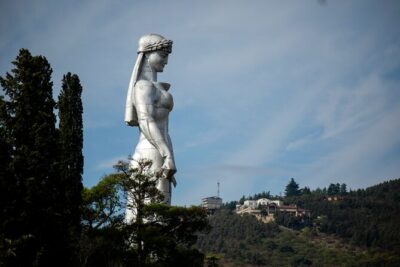
Tbilisi Old Town Walking Tour with a Local Guide
Read our review →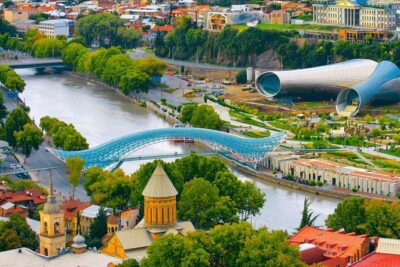
Discover Tbilisi: Hidden Gems and Iconic Sights Walking Tour
Read our review →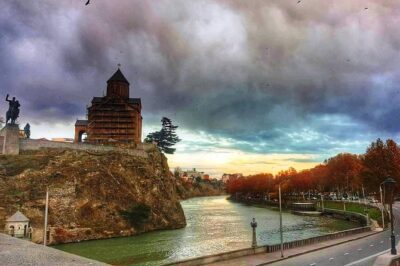
Browse the lists this tour appears in