
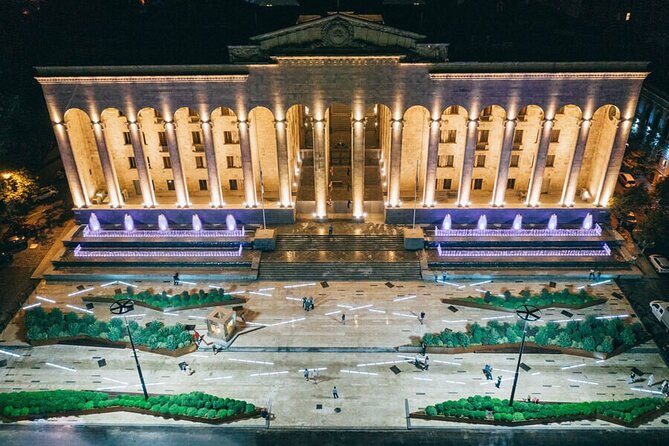
Reviewed · WALKING TOURS
Walking Tour Tbilisi: From the USSR to the 1st Female President
Georgia’s modern political story comes into focus on this compact walk from Parliament to the House of Justice. In less than an hour, you connect the Soviet period, the events of April 9, 1989, Georgia’s first female president, and the country’s changing legal system.
I like the tight route and the way each stop has a clear purpose. I also like that guide Irakli leaves room for questions, rather than simply reciting dates. The main drawback is that you do not enter any of the buildings, so this is a conversation-led history walk, not an architecture tour or a museum visit.
Key points
- A direct route through modern Georgian democracy: Begin at Parliament and finish at the House of Justice.
- Guide Irakli supplies the political context: The tour explains events after the fall of the Soviet Union in clear, approachable terms.
- April 9, 1989 gets its own stop: A scenic park becomes the setting for one of Georgia’s most important modern events.
- Two presidential palaces are part of the story: You learn why Georgia has both the Presidential Palace and Orbeliani Palace.
- A private English-language experience: Only your group takes part, so you can ask questions as you walk.
- A useful one-hour choice: The short format works well when you want political context without giving up half a day.
Parliament is the right place to begin
Meet Irakli in front of the Parliament of Georgia at 8 Shota Rustaveli Avenue. This is a useful starting point because the building is not just a meeting place. It puts you directly beside one of the main institutions in Georgia’s public life.
From here, the tour follows a simple line through central Tbilisi. You are not being taken across the city by vehicle or rushed between far-flung sights. The route links places connected to government, protest, the presidency, and public administration.
That design matters. In 45 minutes to one hour, you need a guide who can keep the story focused. Irakli’s role is to explain how the places around you connect to the political changes Georgia experienced after the Soviet Union ended.
This is not a standard old-town walk. You will not spend the time on medieval churches, balconies, or the usual postcard views. Instead, the subject is modern Georgia: how the country governs itself, how public events shaped its direction, and how national institutions have changed.
A few more things to do in Tbilisi worth a look
- Tbilisi Walking Tour Including Cable Car and Traditional Bakery
★ 5.0 · 1,310 reviews - Tbilisi:Evening Walking & Talking Tour with Wine & Boat Ride
★ 5.0 · 572 reviews - Old Tbilisi Highlights walking tour with wine & 10 tastings
★ 5.0 · 276 reviews
April 9, 1989 and the meaning of the park

One stop takes you through a scenic park where Irakli explains the events of April 9, 1989. This date is central to Georgia’s modern story, and the setting gives the discussion a physical place rather than leaving it as an abstract history lesson.
The tour is especially useful here because political events can be hard to understand when you only encounter them as names and dates. A walk through the area lets you pause, look around, and ask how the event affected Georgia’s path away from Soviet rule.
The supplied information does not promise a long memorial visit or an elaborate ceremony. Expect a short outdoor stop and an explanation from the guide. That is both the strength and the limit of the experience. You get focused context, but not a full historical lecture or an extended museum presentation.
If you know little about Georgia before arriving, this part may be the key to the tour. It gives you a starting point for understanding why independence, public protest, and national identity remain important subjects in the country.
Why Georgia has two presidential palaces
The next major subject is Georgia’s presidency. You learn why the country has two presidential palaces and why the female president moved to Orbeliani Palace in 2018.
This is a distinctive topic because the buildings are more than official residences. Their different roles help explain how Georgia’s presidency has been presented and organized over time. A guide can point out the places and then supply the political background that you would probably miss if you simply walked past them.
The tour focuses on Georgia’s first female president and the move to Orbeliani Palace. That makes this stop especially useful if you want to understand the country’s recent political development rather than only its Soviet past.
You should keep your expectations practical. The tour does not include entry into the Presidential Palace or Orbeliani Palace. You will see the buildings from outside and hear the explanation there. If you are hoping for grand interiors, security details, or an official guided visit inside a government building, this is not that experience.
Still, an exterior visit can work well for this subject. The point is not decorative detail. The point is to understand why these two places matter and how the presidency fits into Georgia’s political structure.
The House of Justice gives the walk a clear finish
The tour ends at the House of Justice on the right bank of the Mtkvari River, at 1 Zviad Gamsakhurdia Named Right Bank. This final stop shifts the focus from the presidency to public services and the legal system.
Here, you learn about key parts of Georgia’s legal system and its role in shaping the country’s current political reality. That gives the walk a useful arc. It begins with Parliament, moves through public memory and presidential power, and ends with the institution most closely linked to state services and legal administration.
The House of Justice is also a practical place to end. You are not left at an unrelated corner of the city after the final explanation. The endpoint is clear, and you can continue with your own plans from there.
Again, you do not go inside. The building is used as a subject for discussion, not as an interior attraction. If you are mainly interested in architecture, this may feel brief. If you want to understand how public institutions fit together, it is a sensible final stop.
Same base, a different sort of day:
- Day Trip to Kakheti Wine Region Including 9 Wine Tastings
★ 5.0 · 2,774 reviews - Highlights of Caucasus Mountains-Jinvali,Ananuri,Gudauri,Kazbegi(Group tour)
★ 5.0 · 2,682 reviews - Day Trip to Kazbegi and Gudauri
★ 5.0 · 2,009 reviews - Day Trip to Mtskheta Gori and Uplistsikhe
★ 5.0 · 1,801 reviews
Irakli’s teaching style is part of the value
The guide can make or break a short history walk. With only about an hour available, a guide who wanders off topic would leave you with fragments. Irakli’s approach, as described through the experience, is attentive and open to questions.
The walk is designed around a few stops, but each one carries a good amount of information. That is why the short duration works better than you might expect. You are not trying to cover every period of Georgian history. You are following one clear thread from Soviet rule to present-day institutions.
The tour is also private, with only your group taking part. That changes the rhythm. You can ask Irakli to clarify a point, request more explanation about a political figure, or slow down if a subject is new to you. In a large group, those questions can be awkward or impossible. Here, they are part of the experience.
The English-language format makes the tour accessible to international visitors, and one account also describes Irakli as accommodating with questions. That matters on a political tour, where unfamiliar names, dates, and institutions can quickly become confusing.
I would not book this expecting a theatrical performance. Irakli’s strength is the clear explanation and conversation. The experience suits you best if you want a guide who can help you make sense of Georgia, not simply point out buildings.
What you can cover in 45 minutes
A 45-minute to one-hour tour has an obvious advantage: it fits into a crowded Tbilisi schedule. You can take it in the morning, between other central-city plans, or as a short orientation early in your visit.
The same short format creates a tradeoff. You will get an introduction, not a complete account of Georgian politics. The tour touches on the Soviet period, April 9, the presidency, the first female president, and the legal system. It cannot fully explain every government, election, conflict, or constitutional change in that time.
That is not a flaw if you treat the walk as a foundation. You will leave with several subjects to explore on your own and a better sense of what you are seeing elsewhere in Tbilisi.
It also helps that the itinerary uses only a few main stops. You are not spending most of the hour walking between points. The route is built around explanation, so the time is used for context rather than distance.
You should allow for ordinary walking and standing outdoors. The activity calls for a moderate level of physical fitness. It is near public transportation, and service animals are allowed. Specific details about step-free access, seating, or restroom availability are not provided, so contact the operator if those points matter to you.
Who will get the most from this walk
I would recommend this tour to you if:
- You want a quick introduction to Georgia’s modern political life.
- You have already seen Tbilisi’s main historic sights and want a different subject.
- You prefer a private conversation to a large scheduled group.
- You enjoy asking questions as you go.
- You want context for the Soviet period and Georgia’s years of independence.
- You have limited time but still want something more substantial than a photo stop.
It may be less suitable if you want to enter government buildings, spend time inside museums, or focus on Tbilisi’s older religious and architectural sights. It is also not the best choice if you want a long, detailed political seminar. The walk gives you a concentrated introduction, not an entire university course.
Families with older children may find the short route manageable, especially if the children are interested in current affairs. The subject matter is political and historical, so it depends more on attention and curiosity than on age alone.
How the value depends on the price
The exact tour price is not provided here, so I cannot tell you if it is the cheapest or most expensive way to learn about Georgian politics. I can still explain what you are paying for.
The main value is the guide’s interpretation. You are not paying for entry tickets, since the buildings are not entered. You are paying for a private English-language explanation that links several public places into one story.
That can be good value if you would otherwise walk past Parliament, the presidential palaces, and the House of Justice without understanding their roles. It is less compelling if you already know Georgia’s recent political history or prefer to read the background independently.
Because the activity lasts about an hour, it also has a low time cost. Even if you later decide that political history is not your main interest, you have not given up a whole day. The private format adds value for anyone who wants direct answers rather than a fixed script.
Before booking, compare the price with the kind of experience you want. A low-cost group walk may cover more sights, while a museum visit may offer more objects and documents. This tour’s advantage is its focused subject and personal discussion.
Practical details before you book
You meet in front of the Parliament of Georgia, at 8 Shota Rustaveli Avenue. The tour finishes at the Public Service Hall, also called the House of Justice, at 1 Zviad Gamsakhurdia Named Right Bank.
The route is offered in English and uses a mobile ticket. Confirmation is provided when you book. Since this is an outdoor walking activity, wear shoes that are comfortable for walking and check the forecast before setting out.
Good weather is required. If poor weather forces cancellation, you are offered another date or a full refund. You can cancel for a full refund up to 24 hours before the start time. Cancellations or changes made less than 24 hours before the start time are not refunded or accepted, and the cut-off follows local time.
The meeting and ending points are near public transportation, but no specific bus or metro directions are supplied. Check the location in advance, especially if you are arriving on a tight schedule.
My recommendation for this one-hour history lesson
Book this walk if you want to understand modern Georgia through the places where its political life unfolds. The route is short, the subject is unusual, and Irakli’s question-friendly style gives the experience more depth than a simple list of landmarks.
Skip it if you need interior visits or prefer ancient history, art, food, or architecture. For everyone else, this is a smart way to spend an hour in Tbilisi, especially near the start of your trip. You will gain a framework for understanding the city and the country, then see later sights with better context.
FAQ
How long does the walking tour last?
The tour lasts approximately 45 minutes to one hour.
Where does the tour begin?
It begins in front of the Parliament of Georgia at 8 Shota Rustaveli Avenue in Tbilisi.
Where does the tour end?
The tour ends at the House of Justice, also known as the Public Service Hall, at 1 Zviad Gamsakhurdia Named Right Bank.
Is the tour offered in English?
Yes. The experience is offered in English.
Do you enter the Parliament, presidential palaces, or House of Justice?
No. The buildings are viewed from outside, and the guide explains their roles and importance during the walk.
Who leads the tour?
The guide is Irakli.
Is this a private tour?
Yes. Only your group participates in the activity.
What happens if the weather is poor?
The experience requires good weather. If it is canceled because of poor weather, you can choose another date or receive a full refund.
Just added in Tbilisi
- Private Adorable City Tour of Tbilisi★ 5.0 · 3 reviews
- full day Kazbegi-Gudauri-jvari -from Tbilisi★ 5.0 · 6 reviews
- Old tbilisi walking tour & wine tasting★ 5.0 · 9 reviews
- Tbilisi Airport to Gudauri, Bakuriani, Batumi, Tbilisi★ 5.0 · 3 reviews
- Wine promenade in hospitable Tbilisi★ 5.0 · 17 reviews
- Vardzia. Lake Paravani, Khertvisi & Lomisa castle, Rabati★ 4.5 · 12 reviews
- Your unique photo session in Tblisi, Georgia★ 3.5 · 4 reviews
- Private Wine Tour In Kakheti Region with 7 Wines and Lunch★ 5.0 · 3 reviews
Walking Tours, compared.

Tbilisi Walking Tour Including Cable Car and Traditional Bakery
Read our review →
Evening Walking & Talking Tour with Wine & Boat Ride
Read our review →
Old Tbilisi Highlights walking tour with wine & 10 tastings
Read our review →
Old Tbilisi Tour: Private Walking Tour With Wine Tasting
Read our review →
Private Tbilisi Food Tour: 9 Tastings Walk in Bohemian District
Read our review →
Tbilisi Old Town Walking Tour with a Local Guide
Read our review →
Discover Tbilisi: Hidden Gems and Iconic Sights Walking Tour
Read our review →
Browse the lists this tour appears in