

Reviewed · TOURS IN TBILISI
Skip the Line: Experimentorium Ticket
The most fun part of Tbilisi’s Experimentorium is that you are not expected to keep your hands behind your back. You can sit on nails, lift a friend, make a thunder effect, draw in sand, and test physics with your own body. It is science presented as play, which makes this a strong rainy-day stop for families.
I like the roughly 80 interactive exhibits, since children learn by trying rather than simply reading labels. I also like the hourly tours, included with admission, and the lively chemical demonstrations, especially the nitrogen show that has become a major highlight.
The main caution is practical: the museum is not large, and you may finish in about an hour if you move quickly. Also, confirm that your mobile ticket is recognized and ask whether the nitrogen show is included, since the available information is not perfectly consistent.
Key points to know before you go

- About 80 hands-on exhibits: You can touch, test, push, sit, listen, and experiment instead of viewing displays from a distance.
- Hourly guided tours: Tours run from 10:00 a.m. to 7:00 p.m., with a new start each hour, and admission includes the excursion.
- The nitrogen show is the big draw: Chemical demonstrations add spectacle to the physics exhibits, but confirm show times and inclusion when booking.
- Good for mixed ages: Children, toddlers, and adults can all take part, although younger children need close supervision.
- A short indoor visit: Plan on about one to two hours. It works well between other Tbilisi sights or during bad weather.
- Check your ticket carefully: A conflicting booking complaint makes it wise to confirm the voucher and admission details before arrival.
What the Experimentorium is really like
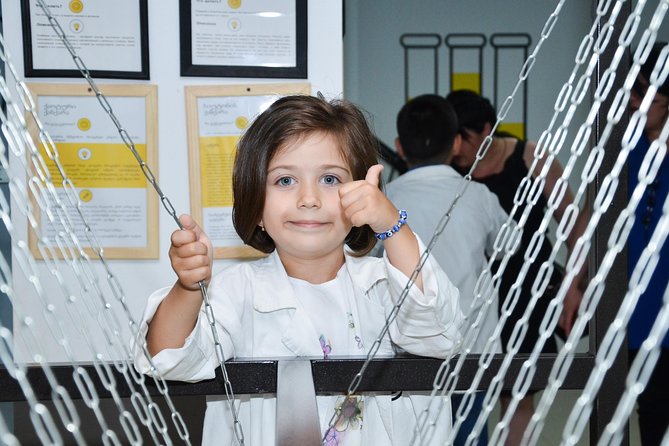
The Experimentorium is a compact science museum built around participation. You are not walking through a long sequence of solemn galleries. Instead, you move from one experiment to the next, trying out familiar physical ideas in ways that feel a little surprising.
The exhibits focus on the laws of physics. The goal is not to give you a university lecture. It is to let you feel the principle first, then understand why it happens. That approach works especially well for children who may lose interest when science is explained only through text.
You might sit on a bed of nails, lift another person with an unusual mechanical setup, or make a thunder effect with your hands. There is also a sand area and a music room where you can make noise and act like a performer. The museum encourages a louder, more playful mood than a traditional museum.
That freedom is part of the appeal. You can laugh, repeat an experiment, and take turns with your family. For adults, the pleasure comes from seeing a simple physics rule produce an unexpected result. For children, the first lesson is often the most useful one: science is something you can test.
Other trips people book in Tbilisi:
- Day Trip to Kakheti Wine Region Including 9 Wine Tastings
★ 5.0 · 2,774 reviews - Highlights of Caucasus Mountains-Jinvali,Ananuri,Gudauri,Kazbegi(Group tour)
★ 5.0 · 2,682 reviews - Day Trip to Kazbegi and Gudauri
★ 5.0 · 2,009 reviews
The hands-on exhibits reward curiosity
The collection includes about 80 exhibits, enough to keep most families busy for a solid hour. The exact experience depends on how long you spend at each station and how crowded the museum is, but the format is easy to understand. Try an exhibit, watch what happens, and move on when you are ready.
The most memorable activities are the ones that make a physical idea feel personal. Sitting on nails sounds uncomfortable until the arrangement spreads your weight in a safe way. Lifting a friend turns leverage into a family challenge. Catching a thunder effect gives electricity a theatrical edge without turning the visit into a technical lesson.
You may also find that not every explanation is placed right beside the exhibit. One useful criticism is that some labels appear elsewhere in the room, so you might need to look around before finding the explanation. If you care about the science behind each activity, take your time and ask a staff member rather than rushing from one station to the next.
The exhibits are best understood as introductions, not full scientific demonstrations. If you already have a strong interest in physics, you may find the explanations light. If you want a lively way to spark a child’s interest, the simple design works well.
Why the hourly tour matters
The museum offers guided excursions each hour from 10:00 a.m. through 7:00 p.m. The tour is included in the admission price, so you do not need to pay extra simply to have someone explain the displays.
A guided start can make a real difference. You learn how to use the more unusual exhibits, and you are less likely to miss the explanation for a station whose instructions are posted in another part of the room. It also gives the visit a clear rhythm instead of leaving you to wander without context.
Language availability needs a little care. Explanations are available in Georgian, Russian, and English, but the language of a particular tour may depend on the schedule. One Russian-speaking group was expected but did not take place, so you should confirm the language in advance if that matters to your visit.
Staff members have been praised for their warm approach. A guide called Ellen, also referred to as Helen in some comments, receives particular credit for helping families during the tour and in the chemical room. Do not count on a specific guide being present, but the experience can be more engaging when a staff member actively demonstrates each station.
Do not miss the chemical and nitrogen demonstrations

The chemical room and nitrogen show add a different mood to the visit. The physics stations let you experiment at your own pace. The show gives you a shared event, with a staff member leading the demonstration while the group watches.
The nitrogen presentation is repeatedly singled out as the strongest part of the experience. It brings cold-temperature chemistry into a format that children can understand through sight and reaction. Some demonstrations also involve tasting a nitrogen-treated sweet known in the supplied material as nitrogen burbushella.
Treat this section with proper care. Liquid nitrogen is not a toy, and children should follow the staff’s instructions closely. One critical comment specifically warns parents to keep an eye on children during the show. That is sensible advice at any science museum where chemicals and very cold substances are involved.
The show may be described separately from the basic museum visit, so ask at the entrance whether it is included in your ticket and when it begins. If it is an important reason for booking, do not assume that arriving at any time guarantees a seat or a demonstration.
Same base, a different sort of day:
- Day Trip to Mtskheta Gori and Uplistsikhe
★ 5.0 · 1,801 reviews - Tbilisi Walking Tour Including Cable Car and Traditional Bakery
★ 5.0 · 1,310 reviews - Day Trip to Armenia Including Homemade Lunch
★ 5.0 · 1,162 reviews - Kakheti Wine Region: Signagi and Bodbe Tour with 10 Wine Tastings
★ 5.0 · 1,019 reviews
How long should you allow?
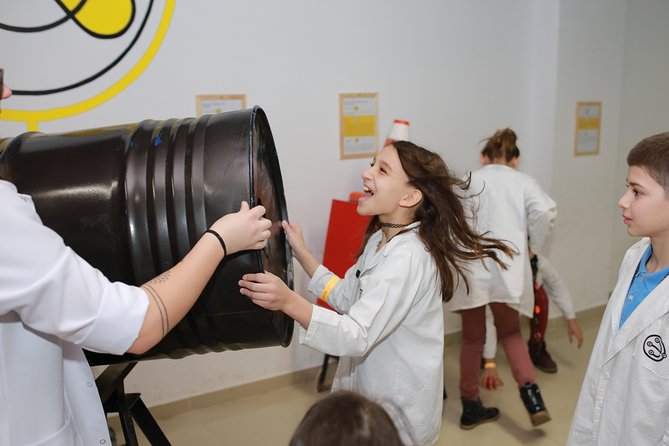
The stated visit length is about one to two hours. That is a fair range for a museum of this size. You can see the main exhibits in roughly an hour, while a guided tour, a chemical demonstration, and time at favorite stations can stretch the visit closer to 90 minutes or two hours.
The museum is not a full-day attraction. That is not a weakness if you plan it correctly. It fits neatly into an afternoon near Rustaveli Street, and it gives you a useful indoor option when rain interrupts sightseeing.
Families with children around six or seven years old appear to get especially good use from the displays, but younger children can also enjoy the physical activities. Toddlers may not understand the science, yet they can still take part in simple interactive stations. Adults should expect to participate rather than simply supervise.
If you are visiting with several children, allow extra time for turn-taking. The museum’s compact size can make favorite exhibits feel busy, and younger children may need help following directions. A shorter visit is better than trying to force every exhibit into a fixed schedule.
Is the $46 price good value?
At $46, this is not a casual low-cost stop, especially if you are paying for several family members. The value depends on what you want from the visit. You are paying for a hands-on indoor activity, skip-the-line access, and a guided excursion rather than for a large museum with many rooms.
I see the price working best for families who will use the interactive stations fully and stay for the demonstration. If you only want to walk through quickly, the visit may feel expensive for one hour in a relatively small museum. If the weather is poor and you need an activity that keeps children involved, the cost becomes easier to justify.
The skip-the-line feature can also matter at a busy time. It saves you from waiting at the entrance, though the museum’s small scale means the overall benefit depends on how many people arrive when you do. Picking a date and time in advance gives you a cleaner plan, particularly if you are fitting the museum between other appointments.
Because the booking information has a conflicting admission complaint, I would check the confirmation carefully before paying. Make sure the voucher identifies Experimentorium clearly and that the mobile ticket is accepted. This is a small step, but it protects the value of the purchase.
Getting there and planning the visit
The museum is near public transportation, making it practical to reach without arranging a private transfer. A parking space is also reported to be available, although you should not assume that parking will always be open or convenient.
The listed start time is 10:00 a.m., and tours continue hourly through 7:00 p.m. Choose a time that leaves room for the guided excursion and any show you want to attend. If you arrive near the end of the day, ask how much time remains for the exhibits and demonstrations.
A mobile ticket makes the entrance process simple in theory. Keep the confirmation easy to access on your phone, and check the date and starting time before leaving. Since there is a complaint about a ticket not being recognized, it is sensible to confirm the booking with the museum or provider if anything on the voucher looks unclear.
The visit suits most people, but children must be supervised. The interactive design encourages movement, noise, and experimentation. That is exactly what makes it fun, but it also means parents should stay close during the chemical demonstration and at any station involving lifting or unusual equipment.
Who will enjoy the Experimentorium most?
This is a strong choice for families looking for an activity that combines learning and play. Children who like pressing buttons, building, making noise, and seeing immediate results will have plenty to do. It also gives adults a reason to participate rather than wait on a bench.
The museum is particularly useful during bad weather. One to two hours indoors can rescue a wet afternoon, and the compact layout makes it easy to manage alongside a wider Tbilisi sightseeing plan.
It can also work for adults, but expectations matter. You will probably enjoy the clever mechanisms and the chance to test them yourself. Still, the explanations are aimed at broad family appeal, not at advanced science enthusiasts. If you want detailed technical information, you may find the museum too light.
The strongest visit combines the exhibits with the guided tour and nitrogen show. Going only for a quick look at the displays gives you the least complete version of the experience.
What I would do on arrival
I would arrive with the mobile ticket ready, then ask three quick questions:
- Which language is the next guided tour?
- What time is the nitrogen or chemical show?
- Is that show included in my selected ticket?
After that, I would join the tour rather than immediately racing through the exhibits. The guide can show you how the unusual stations work and help you find explanations that are not posted beside each activity.
Once the tour ends, I would return to the exhibits that interested the children most. That second pass is where the museum becomes more than a series of quick tricks. You can try the activity again, explain the physics in simple terms, and let each child have a turn.
Cancellation and booking flexibility
You can cancel for a full refund if you do so at least 24 hours before the experience begins. Cancellations made within 24 hours are not refunded, and changes inside that period are not accepted.
The cut-off uses local time in Tbilisi. If your schedule is uncertain, book only when you are reasonably sure of the date, and check the voucher as soon as you receive confirmation.
Should you book this experience?
Book it if you want a lively, family-friendly indoor activity with real participation, especially if rain is in the forecast. The hands-on physics exhibits, hourly tour, and nitrogen demonstration give you more to do than a quick display-only museum visit.
I would be more cautious if you are an adult seeking advanced science explanations, or if $46 feels high for a one-hour attraction. I would also confirm the ticket and show details before arrival because of the inconsistent admission information.
For most families, the best plan is simple: choose a convenient time, confirm the mobile voucher, ask about the show, and allow 90 minutes. With that preparation, the Experimentorium offers a cheerful break from standard sightseeing and a good chance to get children talking about how things work.
FAQ
Where is the Experimentorium?
The Experimentorium is in Tbilisi, Georgia, near public transportation. It is also described as being near Rustaveli Street.
How much does the experience cost?
The listed price is $46.
How long does a visit take?
The approximate duration is one to two hours.
What time does the museum open?
Tours begin at 10:00 a.m. and continue every hour through 7:00 p.m.
Is a guided tour included?
Yes. The excursion is included in the ticket price, with a new tour beginning every hour.
Which languages are available?
Explanations are available in Georgian, Russian, and English. The language of a specific scheduled group should be confirmed in advance.
Is the ticket mobile?
Yes. The experience provides a mobile ticket.
Is the museum suitable for children?
Yes. The interactive exhibits are designed for visitors of different ages, and most people can participate. Children should be watched closely, especially during chemical demonstrations.
Can I cancel for a full refund?
Yes. You can receive a full refund by cancelling at least 24 hours before the experience start time. Cancellations within 24 hours are not refunded.
Just added in Tbilisi
- 8-Day Trekking Group Tour in Svaneti★ 5.0 · 21 reviews
- Private five days tour to Svaneti-Mestia, Ushguli, Becho,Chalaadi★ 5.0 · 21 reviews
- Join a Local for a Market Tour, Cooking Class and Meal in her Tbilisi Home★ 5.0 · 15 reviews
- Chiatura and Katskhi Pillar One Day Urbex Tour★ 5.0 · 14 reviews
- Soviet Story – Private day trip to Chiatura, Stalin’s museum and Katskhi pillar★ 4.5 · 15 reviews
- Full Day Tbilisi City Tour with Wine Tasting & Cable Car Ride★ 5.0 · 18 reviews
- Tbilisi Walking Tour Including Cable Car and Wine Tasting★ 5.0 · 16 reviews
- David Gareja, Kakheti and Signagi city of love One Day Tour★ 5.0 · 25 reviews
Tours in Tbilisi, compared.
Day Trip to Kakheti Wine Region Including 9 Wine Tastings
Read our review →
Highlights of Caucasus Mountains-Jinvali,Ananuri,Gudauri,Kazbegi(Group tour)
Read our review →


Tbilisi Walking Tour Including Cable Car and Traditional Bakery
Read our review →

Kakheti Wine Region: Signagi and Bodbe Tour with 10 Wine Tastings
Read our review →
Mtskheta,Jvari,Bazaar,wine tasting,Chronicles of Georgia
Read our review →Browse the lists this tour appears in