
Reviewed · CITY TOURS
Private Walking Tbilisi City Tour
Tbilisi reveals itself best on foot, where grand churches, crooked lanes, sulfur baths, modern bridges, and small local details sit close together. This private tour connects the city’s major sights in about four hours, with a cable-car ride to Mother of Georgia adding a fine view over the old town.
I like the personal format, since your guide can adjust the pace and answer your questions. I also like the mix of famous sights and lesser-known details, from the Tamada statue and Rezo Gabriadze’s clock tower to Georgia’s toastmaster tradition. The main drawback is simple: at $45 per person, this may feel expensive if you want a broad city tour by car rather than a focused walking experience.
Key points to know
- A private four-hour route: Only your group takes part, with hotel pickup and drop-off included.
- The best city view comes by cable car: Ride from Rike Park toward Narikala and Mother of Georgia.
- Old Tbilisi gets the most attention: Churches, the sulfur bath district, Shardeni Street, and a waterfall fill the second half.
- Strong guide element: Luka, Kate, Nico, Mariam, Nino, Sally, David, Roma, Nika, Magda, and Oki are among the guides praised for friendly service and clear explanations.
- Good for first-time visitors: The route gives you a useful introduction to Tbilisi’s layout, symbols, faith, and customs.
- Dress with churches in mind: Shorts are not allowed inside, and women must cover their heads.
Why this four-hour walk works as a first look at Tbilisi
Tbilisi is not a city you understand from a string of photo stops. Its character comes from the way different eras share the same streets. A medieval church can sit near a modern glass bridge, while sulfur steam rises from an old bathhouse district below a hillside fortress.
This tour gives you that contrast in a compact format. You begin near the central river area, cross parks and squares, ride up the hill by cable car, then return to the old town on foot. The route is full, but it does not try to cover every corner of Tbilisi.
The private setup matters. You are not waiting for a large group to take photos or listen to a long speech. Guides such as Mariam and Roma have been able to make small changes for personal needs, while Nico is praised for handling extra requests. That flexibility is one of the clearest reasons to choose this tour instead of a cheaper group walk.
You should still expect a real walking tour. The listed stops are short, often five or ten minutes, and the connections between them require walking on city streets and through historic districts. If you prefer to see a wider area from a vehicle, another format may suit you better.
A few more things to do in Tbilisi worth a look
- Tbilisi Walking Tour Including Cable Car and Traditional Bakery
★ 5.0 · 1,310 reviews - Tbilisi:Evening Walking & Talking Tour with Wine & Boat Ride
★ 5.0 · 572 reviews - Old Tbilisi Highlights walking tour with wine & 10 tastings
★ 5.0 · 276 reviews
Starting at the meeting point near the old city

The tour begins at the Traveler’s Meeting Point, a social space where you can meet people, play board games, listen to music, or have a glass of wine. The stop itself is brief, around ten minutes, but it gives the tour a relaxed start rather than dropping you straight into a lecture.
Your guide also meets you at your hotel reception, so the practical beginning is easy. Hotel pickup and drop-off are included, which adds value in a city where finding a meeting point can take time.
The meeting point is not one of Tbilisi’s headline sights, so do not expect a major attraction here. Its purpose is orientation and welcome. The tour is offered in English, and past guide names include Luka, Nino, Sally, David, and Kate, among others.
Metekhi Church and the story of King Vakhtang
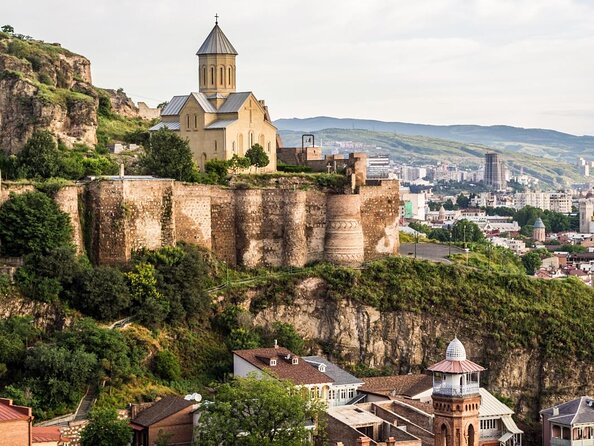
Metekhi Cathedral is one of the strongest early stops. It sits on a cliff above the Mtkvari River, giving you both a religious landmark and a sense of Tbilisi’s steep, uneven setting.
The church is linked with King Vakhtang Gorgasali, who is traditionally associated with the founding of Tbilisi. The site also connects to the story of Saint Shushanik, who was reportedly brought here in the seventh century. Your guide can help separate legend, tradition, and established history, which is useful in Georgia, where old stories often remain part of how people understand a place.
Just outside the church, the monument to Vakhtang Gorgasali adds a face to the story. He ruled Iberia, the kingdom also known as Kartli, during the late fifth and early sixth centuries. His reign involved conflict with Sasanian Iran, ties with Byzantium, and major changes in the Georgian church.
This is a short stop, so the value depends heavily on your guide. Nino has been praised for keeping historical explanations varied and responding closely to questions. If you want detailed history, say so early. One person who took the tour wanted more cultural and historical facts, which is a useful reminder that guide style can vary.
Europe Square, Rike Park, and the Bridge of Peace
The route continues across Europe Square, where you hear about Georgia’s relationship with the European Union. That topic is important to modern Georgians, and it gives the tour a present-day political thread rather than keeping the discussion entirely in the past.
Rike Park lies along the Mtkvari and is one of Tbilisi’s newer public spaces. It includes fountains, paths, children’s areas, climbing walls, oversized chess boards, bars, and restaurants. The park’s location also makes it the natural starting point for the cable car.
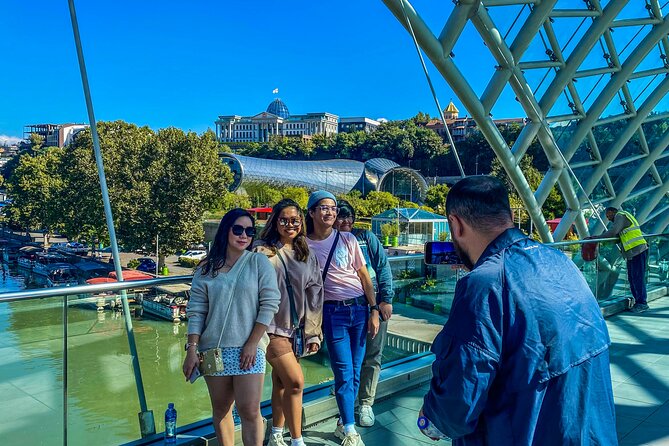
Nearby, the Bridge of Peace crosses the river in a curved glass-and-steel form. It opened in 2010 and contains more than 10,000 LED bulbs, which are turned on each evening before sunset. The bridge arrived from Italy in 200 separate pieces, an odd but memorable detail for your guide to explain.
I like this section because it shows modern Tbilisi without leaving the old center. The drawback is that the stops are quick. You have about five minutes at both Europe Square and the bridge, so this is more of a guided introduction than a chance to linger.
Same base, a different sort of day:
- Day Trip to Kakheti Wine Region Including 9 Wine Tastings
★ 5.0 · 2,774 reviews - Highlights of Caucasus Mountains-Jinvali,Ananuri,Gudauri,Kazbegi(Group tour)
★ 5.0 · 2,682 reviews - Day Trip to Kazbegi and Gudauri
★ 5.0 · 2,009 reviews - Day Trip to Mtskheta Gori and Uplistsikhe
★ 5.0 · 1,801 reviews
The cable car to Mother of Georgia
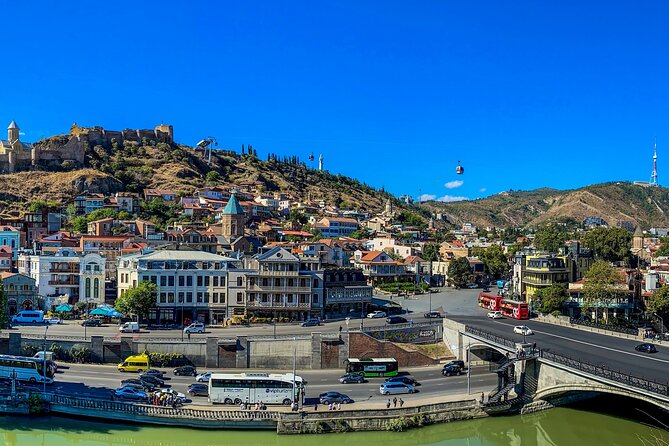
The cable car is the tour’s clearest built-in highlight. From Rike Park, you ride toward the upper station near Narikala and Mother of Georgia. The ride is included in the $45 price, so you do not need to arrange this separately.
At the top, Kartlis Deda, or Mother of Georgia, rises above the city. The 20-meter aluminum statue was created by sculptor Elguja Amashukeli and placed on Sololaki Hill in 1958, during Tbilisi’s 1,500th anniversary celebrations.
The figure holds a bowl of wine in one hand for friends and a sword in the other for enemies. It is a compact symbol of Georgian hospitality and readiness to defend the country. That combination tells you something important about Georgian identity without requiring a long museum visit.
You get around ten minutes at the statue, along with broad views over Tbilisi. The cable car does not operate in windy weather, and that is the main practical risk in this part of the tour. The experience continues in poor weather, so dress for the forecast. If the cable car is stopped, the route will not deliver the same hilltop moment.
Anchiskhati Basilica and the clock tower
After the hilltop section, the tour returns to the old city and reaches Anchiskhati Basilica on Shavteli Street. Dating to the sixth century, it is regarded as Tbilisi’s oldest surviving church.
The basilica was originally linked with the Nativity of the Virgin Mary. Its current name came later, after an image of Christ was moved from the Anchi church to this building in the seventeenth century. The church also connects with a family tradition of pastors and calligraphers, giving your guide several threads to explain beyond the building itself.
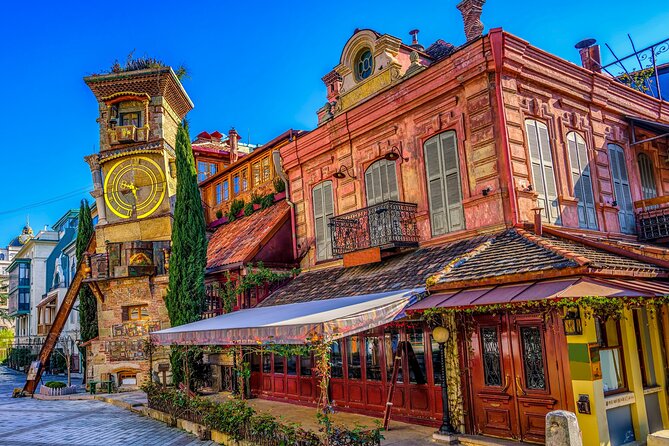
Nearby, Rezo Gabriadze’s marionette theater and clock tower provide a sharp change of mood. The tower is decorated with tiles designed by Gabriadze, and an angel appears each hour to ring a bell. A small puppet show takes place at noon and 7 p.m., though your tour timing may not match either performance.
The clock tower is one of those places that rewards a quick pause. It is not ancient, yet it feels perfectly at home among the old streets. The stop lasts about ten minutes, enough to see the tower and hear its story, but not enough to attend a full theater performance.
Sioni Cathedral, the Tamada, and Georgian customs

Sioni Cathedral sits on the street of the same name in the upper Kala district. The site is linked by tradition to Vakhtang Gorgasali and to an earlier church from the fifth century.
The tour’s religious stops are short, but together they give you a useful sense of Georgian Orthodox life and the long history of Tbilisi’s old center. Remember the dress rules: shorts are not allowed inside churches, and women must cover their heads.
The Tamada statue provides a welcome change from church architecture. A tamada is the toastmaster who guides a Georgian feast, choosing the order and meaning of the toasts. Your guide explains this custom, which helps you understand why Georgian meals are treated as social rituals rather than quick occasions to eat.
Guide Sally has been praised for recommending Georgian red wine, and other guide accounts mention local bread, lemonade, and wine tasting as memorable touches. These items are not listed as standard inclusions, so treat them as possible guide-specific additions rather than something guaranteed in the price.
Shardeni Street, sulfur baths, and Leghvtakhevi Waterfall
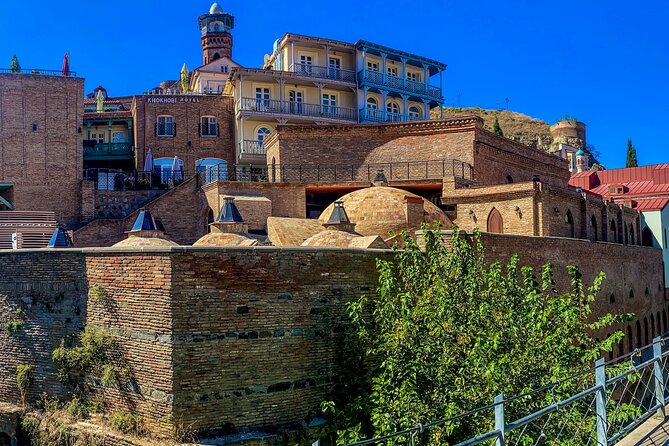
The final stretch brings you through Jan Shardeni Street, one of the old town’s best-known pedestrian lanes. It is lined with places to stop and gives you a sense of how central this district is to Tbilisi’s social life.
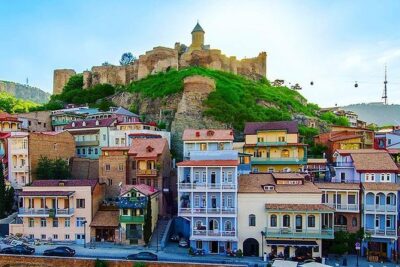
Then comes Abanotubani, the sulfur bath quarter. The name refers to the old town district, while Abanos Kucha is the street of public bathhouses fed by hot sulfur springs. Tbilisi’s name is traditionally linked to warm waters, so this is more than a quick photo stop. It connects the city’s setting, name, and long bathing culture.
The tour ends at Leghvtakhevi Waterfall, a surprising natural feature tucked into the city. It is a popular place to cool off in hot weather and gives the walk a softer finish after churches, statues, bridges, and streets.
These last stops are allotted only about five minutes each. You will see the main points, but you will not have time for a bath, a long meal, or a slow exploration of every lane. If you want to use a sulfur bath, return later and plan that as a separate activity.
What $45 per person includes

At $45 per person, the price is fair if you value a private guide, hotel transportation, and a tightly planned introduction to central Tbilisi. The cable-car fare is included, and you also get online support before the tour.
The price is less convincing if you mainly want transportation. A private car tour can cover more ground, and one piece of feedback specifically argued that this walking route was not worth the cost compared with a larger car-based tour.
I see the value this way: you are paying for interpretation and flexibility, not just for a list of monuments. A guide who can adjust the route, answer questions, take photos, and explain local customs can make the same streets far more useful to you than a self-guided walk.
Gratuities are not included. Since guide quality is central to the experience, plan to tip separately if your guide gives you the personal, well-organized service this tour is designed to provide.
Who should book this Tbilisi walk
I would choose this tour for a first visit, especially if you have only a short stay and want the old city explained in one outing. It suits couples, families, and small groups who prefer a private pace and want hotel pickup.
It is also a good match if you care about local customs as much as monuments. The tamada tradition, Georgian church etiquette, the symbolism of Mother of Georgia, and the country’s European ties give the route more meaning than a basic sightseeing loop.
You may want another option if you dislike walking, need long visits at each sight, or want to cover distant parts of Tbilisi. The tour stays focused on the central districts, and several stops are brief.
Guide quality appears to be a major part of the experience. Names praised for friendly, clear service include David, Luka, Kate, Nico, Mariam, Nino, Sally, Roma, Nika, Magda, and Oki. You cannot request a particular guide based on the information provided, but the strong range of individual feedback suggests the company has several capable options.
Should you book it?
Book this tour if you want a private introduction to central Tbilisi with a cable-car view, old churches, city stories, and a guide who can adapt to your interests. The hotel pickup and drop-off make the four-hour outing easy to fit into a first day.
Skip it if your priority is covering the whole city by vehicle or spending a long time inside each attraction. At $45 per person, the tour earns its price through personal guiding, not sheer distance. For most first-time visitors who enjoy walking and want context for what they see, it is a useful and well-shaped start to Tbilisi.
FAQ
How long does the Private Walking Tbilisi City Tour last?
The tour lasts approximately four hours.
What is the price of the tour?
The listed price is $45 per person.
Is hotel pickup included?
Yes. The guide meets you at your hotel reception, and hotel drop-off is also included.
Is the tour private?
Yes. Only your group participates in the activity.
Is the tour offered in English?
Yes. English is the listed tour language.
Is the cable-car ride included?
Yes. The ride from Rike Park toward the upper station near Narikala and Mother of Georgia is included.
What happens if the cable car is not operating?
The cable cars do not operate in windy weather. The tour still operates in all weather conditions, so dress according to the forecast.
What should I wear when visiting churches?
Shorts are not allowed inside churches, and women need to cover their heads.
Are gratuities included?
No. Tips for the tour guide are not included.
Can I cancel for a full refund?
Yes, if you cancel at least 24 hours before the experience start time. Cancellations made less than 24 hours in advance are not refunded, and changes within that period are not accepted.
Just added in Tbilisi
- Join a Local for a Market Tour, Cooking Class and Meal in her Tbilisi Home★ 5.0 · 15 reviews
- Chiatura and Katskhi Pillar One Day Urbex Tour★ 5.0 · 14 reviews
- Soviet Story – Private day trip to Chiatura, Stalin’s museum and Katskhi pillar★ 4.5 · 15 reviews
- Full Day Tbilisi City Tour with Wine Tasting & Cable Car Ride★ 5.0 · 18 reviews
- Tbilisi Walking Tour Including Cable Car and Wine Tasting★ 5.0 · 16 reviews
- 8-Day Trekking Group Tour in Svaneti★ 5.0 · 21 reviews
- Private five days tour to Svaneti-Mestia, Ushguli, Becho,Chalaadi★ 5.0 · 21 reviews
- Kakheti: David Gareji Sighnaghi Bodbe & Rainbow Mountains★ 5.0 · 26 reviews
City Tours, compared.
Kakheti;City of Love Sighnaghi, Bodbe. KTW. Wine House Group tour
Read our review →
Mtskheta – Jvari. Full City Tour on Hop On Hop Off Bus
Read our review →
Day tour to Chronicles of Georgia, Gori city, Uplistsikhe cave
Read our review →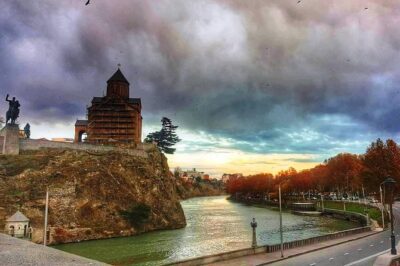

Tbilisi city tour PRIVATE excursion Airport and hotel pickup INCL
Read our review →
Tbilisi City Tour, Most Popular Tourists Destinations In The Capital Of Georgia
Read our review →
Browse the lists this tour appears in