
Reviewed · CITY TOURS
Private Walking Tbilisi City Tour (Day Trip)
Tbilisi packs an unusual amount into one walk: a fortress above the city, hot springs below it, a mosque, synagogue, churches, a waterfall, and a sleek modern bridge. This 6 to 7 hour tour gives you the useful big picture before you explore the capital on your own.
I like the multi-faith route, which treats Tbilisi as more than a collection of Orthodox churches. I also like the practical coverage: you see major sights such as Narikala Fortress, Rustaveli Avenue, Metekhi Cathedral, and the Bridge of Peace in one day. The main drawback is pace. With 14 stops and no transportation included, this is a long walking day, and the shared format can feel less personal than the word private suggests.
Key points to know before booking
- A full city day on foot: Plan for 6 to 7 hours, with much of the route in and around Old Tbilisi.
- Georgia’s religious mix: The route includes a mosque, Great Synagogue, Georgian Orthodox churches, Catholic and Gregorian churches, and the Ateshga pagan temple site.
- Guides named Temo and Teimuraz: These English-speaking guides have been singled out for detailed explanations, patience, and friendly service, though guide assignment is not guaranteed.
- No transport included: You arrange your own way to the starting point, and the activity ends back there.
- A strong value at $59: The price covers a professional guide and bottled water, but not entrance fees beyond the included Narikala access or any transport.
- Weather and minimum numbers matter: Poor weather or too few bookings can lead to a new date, another activity, or a full refund.
Why this Tbilisi walk works well as a first look
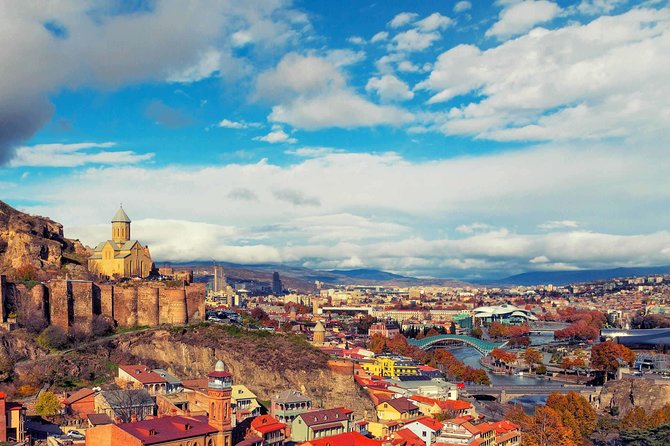
The best reason to book this tour is the route’s range. In one day, you move from the medieval core to the grander 19th and 20th century city, then back into the old lanes along the Mtkvari River.
That variety helps you understand Tbilisi’s shape. The old districts are close-packed, with balconies, churches, baths, and narrow streets. Rustaveli Avenue feels more formal and modern, lined with theaters, salons, and major civic buildings. The riverfront adds another layer, with Metekhi above one bank and Rike Park and the Bridge of Peace below.
You also get stories that make the sights easier to remember. Tbilisi’s name is linked to tbili, the Georgian word for warm, and the city’s founding legend involves King Vakhtang Gorgasali, a falcon, and hot springs. At Leghvtakhevi, the sulfur-water story becomes a real place, complete with a 22-meter waterfall.
The tour is offered in English and includes bottled water for each participant. That sounds small, but on a long walking day it is useful. The experience is described as shared and can include up to 100 people, so you should not expect the quiet, flexible rhythm of a truly private guide.
A few more things to do in Tbilisi worth a look
- Tbilisi Walking Tour Including Cable Car and Traditional Bakery
★ 5.0 · 1,310 reviews - Tbilisi:Evening Walking & Talking Tour with Wine & Boat Ride
★ 5.0 · 572 reviews - Old Tbilisi Highlights walking tour with wine & 10 tastings
★ 5.0 · 276 reviews
Narikala Fortress and the old city’s layered faiths
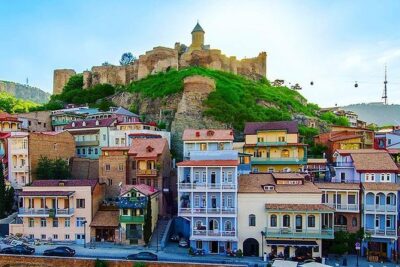
The day begins with Narikala Fortress and the old part of Tbilisi. This is the right place to start because the high ground gives you an immediate sense of how the city fits together. The fortress itself receives about 50 minutes, and admission is included.
Around this area, the guide brings together several of the city’s most important religious buildings and cultural landmarks. You may see typical Tbilisi houses with wooden balconies, the Anchiskhati Basilica, Catholic and Gregorian churches, a Muslim mosque, the Great Synagogue, and Ateshga, described as a former pagan temple site.
That grouping is the heart of the tour. Tbilisi’s identity is not explained by one faith or one empire. The route shows how different communities have occupied the same urban center over time. I especially value this part because it gives you context before you begin ticking off individual monuments.
Narikala is also one of the more physically demanding parts of the day. The route includes old streets, slopes, and uneven surfaces, so comfortable shoes are important. The schedule allows about 50 minutes here, but the full walking day continues for hours, not just around the fortress.
Sulfur baths, Abanotubani, and the falcon legend
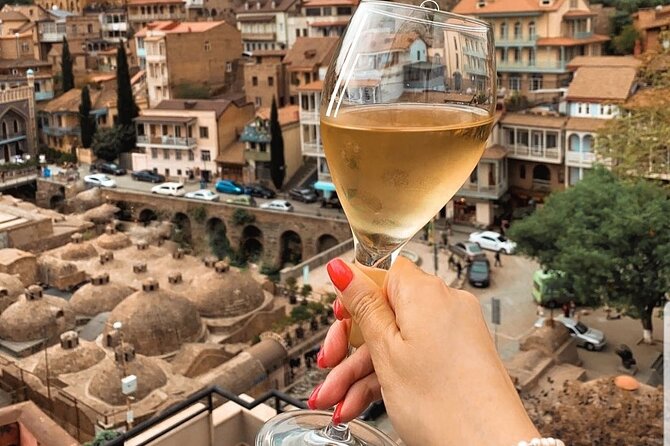
The sulfur-bath district is one of Tbilisi’s most distinctive areas. The tour gives about 30 minutes to the sulfur baths and another 15 minutes to Abanotubani, the historic neighborhood built around the springs.
You will hear the familiar founding story of Vakhtang Gorgasali’s falcon falling near the hot springs. In the tale, the discovery helped lead to the choice of Tbilisi as a capital. The story works best when you connect it to the setting: domed bathhouses, warm mineral water below the city, and the old streets gathered around them.
This is mainly a viewing and explanation stop. The tour information does not include a bath session, so do not book expecting time to soak. You see the historic bath area and learn why it matters.
The short 15-minute Abanotubani stop may feel brief, but the district is compact and works well as part of the larger route. If you want a long photo session or a bathhouse visit, you will likely need to return independently.
Rustaveli Avenue and Tbilisi’s newer face
After the old city, the route moves to Rustaveli Avenue for about an hour. This is the tour’s clearest change of mood. Instead of tight medieval lanes and balconies, you see the grand avenue and parts of the city built up after the 20th century.
The named sights include the Rustaveli Drama Theater, the State Academic Theater of Opera and Ballet, the First Gymnasium, and art salons. The avenue helps explain Tbilisi as a capital with formal cultural institutions, not only a historic quarter.
An hour is useful here because the avenue deserves more than a quick photograph. Your guide can connect the buildings to the city’s cultural life and explain how this newer district differs from Old Tbilisi.
The tradeoff is that this is less intimate than the old lanes. If your main goal is atmospheric streets and old masonry, Rustaveli may feel like a slower middle section. If you want a rounded view of the capital, it is an important change of scene.
Same base, a different sort of day:
- Day Trip to Kakheti Wine Region Including 9 Wine Tastings
★ 5.0 · 2,774 reviews - Highlights of Caucasus Mountains-Jinvali,Ananuri,Gudauri,Kazbegi(Group tour)
★ 5.0 · 2,682 reviews - Day Trip to Kazbegi and Gudauri
★ 5.0 · 2,009 reviews - Day Trip to Mtskheta Gori and Uplistsikhe
★ 5.0 · 1,801 reviews
Metekhi Cathedral above the Mtkvari
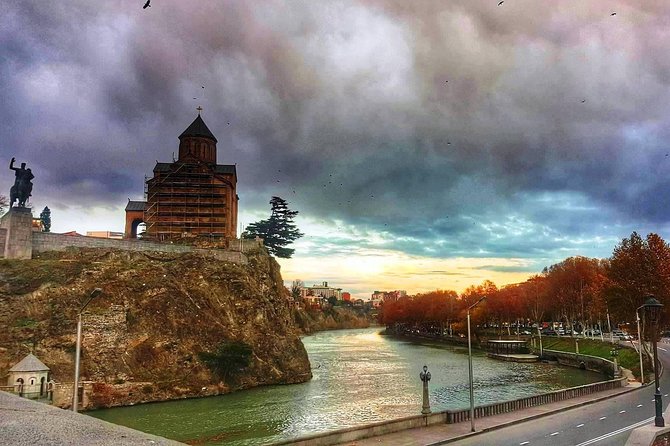
Metekhi Cathedral receives about 15 minutes, but its setting gives the stop more weight than the clock suggests. King Vakhtang I Gorgasali is associated with the church and fortress here, as well as a royal residence. The name Metekhi refers to the area around the palace.
The elevated position helps you understand why this was a strategic and royal site. It also connects several parts of the city’s story: the king linked to Tbilisi’s founding traditions, the river below, and the old districts spreading around it.
Fifteen minutes is enough for an explanation and photographs, but not for a long interior visit. As with several stops on this tour, the value comes from the guide’s context rather than from extended time at one monument.
The Bridge of Peace and Rike Park
The Bridge of Peace is Tbilisi’s sharpest modern contrast to the old city. Built in 2009 and 2010, it was designed by Italian architect Michele De Lucchi, with lighting by French designer Philippe Martinaud.
The bridge gets about 15 minutes, followed by another 15 minutes in Rike Park. Together, these stops show how Tbilisi has reshaped its riverfront while keeping the old city close at hand.
Rike Park hosts festivals such as Tbilisoba. That gives the park a civic role beyond being a pleasant open space. The visit is short, but it gives you a good pause between the historic quarters and the next group of old-city sights.
The bridge itself is modern and visually strong, but it may divide opinion. Some people enjoy the glass-and-steel contrast; others prefer the older buildings around it. The tour does the useful thing by placing it in the same day as Narikala, Sioni, and Anchiskhati, letting you judge the contrast for yourself.
Kartlis Deda and the city’s national symbol
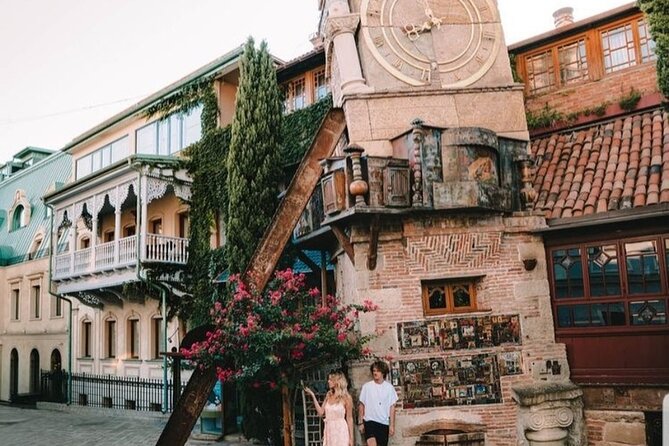
Kartlis Deda, or Mother of Georgia, receives about 15 minutes. The figure holds wine for friends and a sword for enemies, a simple image that explains the symbol without a long lecture.
This is one of the more memorable cultural stops because the statue represents hospitality and defense at the same time. The guide also connects it to Georgian sculptor Elguja Amashukeli, whose work is tied to the Anchiskhati area.
The statue is best understood with the rest of the route. Earlier, you see the old walls, churches, and fortress. Here, you get a modern national symbol looking over the city. The stop is brief, but the story is easy to carry with you after the tour.
Anchiskhati, Sioni, and Tbilisi’s church history
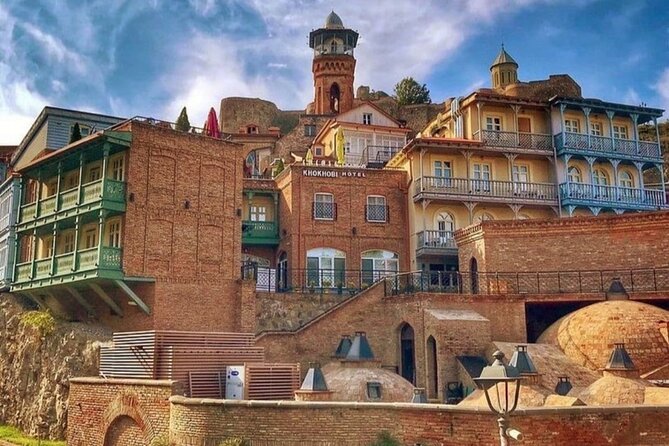
Anchiskhati Basilica is described as Georgia’s oldest surviving church and dates to the sixth century. About 15 minutes here gives you a direct link to the early Christian city.
The stop also includes an artistic connection. A studio belonging to Georgian sculptor Elguja Amashukeli was located here. That detail gives Anchiskhati a second life as a working cultural place, not only an old church.
Sioni Cathedral receives another 15 minutes. Its origins reach back to the sixth and seventh centuries, though invasions and rebuilding changed the structure over time. The present church is based on a 13th-century version, with later changes from the 17th through 19th centuries.
Sioni served as the main Georgian Orthodox cathedral and the seat of the Catholicos-Patriarch of All Georgia until the Holy Trinity Cathedral was consecrated. That fact helps you place the church within Georgia’s religious institutions rather than seeing it as only another old building.
The timing is tight, especially if services or other activity affect access. The tour gives you an introduction and historical frame, not an unhurried church study.
The Great Synagogue, Jumah Mosque, and a broader Tbilisi
The Great Synagogue of Tbilisi receives about 15 minutes. Built between 1895 and 1903, it was established by Georgian Jews from Akhaltsikhe who moved to Tbilisi in the late 19th century. This is why it is also called the synagogue of the people of Akhaltsikhe.
That background is valuable because it links the building to a specific Jewish community and migration pattern. You get more than a quick exterior stop. You get a reason for the synagogue’s name and place in the city.
The route also includes the Muslim mosque, identified in the highlights as Jumah Mosque, along with Catholic and Gregorian churches. Tbilisi’s multi-faith character is one of the strongest reasons to choose this tour over a route focused only on Georgian Orthodox monuments.
The supplied schedule gives the Great Synagogue 15 minutes, and the mosque appears within the broader old-city section rather than with its own listed time. Plan for short visits and listen closely to the guide’s explanations.
Leselidze Street and Rezo Gabriadze’s marionette theater
Leselidze Street gets about 15 minutes. It links old and new parts of the city, making it a useful connecting route rather than a single grand monument.
The street is also a reminder that Tbilisi is a lived-in capital. You move through spaces that connect historic buildings, shops, and newer city life. The value here lies in seeing how the districts meet.
The Rezo Gabriadze Marionette Theater receives about 10 minutes. It is one of Tbilisi’s best-known sights, and the theater’s shows are known for their depth and feeling. The short stop is enough to identify the theater and explain its importance, but it does not include a performance.
If you want to attend a show, you would need to arrange that separately. The tour gives you a useful orientation so you know where the theater is and why it matters.
Leghvtakhevi Waterfall: a final old-city surprise
The final listed stop is the Dzveli Tbilisi Sulphur Waterfall, also called Leghvtakhevi Waterfall. You get about 20 minutes here.
The waterfall is 22 meters tall and sits in a place connected to the sulfur-water district. The name Leghvtakhevi comes from the Georgian word leghvi, meaning fig, because many fig trees once grew around the area.
This is a pleasing finish because it changes the pace again. After churches, streets, bridges, and city history, you reach a small natural feature inside the old urban core. It also gives you another angle on the hot-spring story that began earlier in the day.
Is $59 a fair price for this walking tour?
At $59 per person, the value depends on how much structure you want. You receive a professional English-speaking guide, bottled water, and a route that covers 14 stops over roughly 6 to 7 hours.
For a first day in Tbilisi, that is a fair package. You are paying for orientation, local context, and the convenience of moving through many districts with a guide rather than assembling the route yourself.
The price does not include transportation. It also does not promise extended entry time at every church or attraction. Narikala admission is included, while the other listed stops are marked as free admission.
The shared format is the biggest question. The activity is described as a shared city tour with a maximum of 100 people, despite the private wording in its title. If you want a personal pace, long photo stops, or easy changes to the route, confirm the group arrangement before booking.
Who will enjoy this long city walk?
I would choose this for a first visit when you want the main framework of Tbilisi in one day. It suits people who like history, architecture, religious sites, city legends, and a steady walking route.
It also suits you if you want an English-speaking guide to explain the connections between places. Guides named Temo and Teimuraz have been praised for detailed storytelling, helpful service, and close attention to the group. They are not guaranteed, but their names are useful to know when you confirm your booking.
You should think twice if you dislike long walks, have limited time, or want to linger inside each building. The tour covers a lot, and the 15-minute stops are designed for an overview rather than a slow visit.
Confirmation is provided at booking. Most people can participate, but the day requires good weather. If poor weather cancels the activity, you are offered another date or a full refund. The same applies if the minimum number of participants is not reached. You can cancel for a full refund up to 24 hours before the start time.
Should you book the Tbilisi City Tour?
Book it if you want a broad, guided introduction to Tbilisi and like the idea of seeing its Orthodox, Catholic, Gregorian, Jewish, and Muslim landmarks in the same day. The mix of Narikala, sulfur baths, Rustaveli Avenue, the Bridge of Peace, and Leghvtakhevi Waterfall gives you a clear feel for the city’s many layers.
Skip it if you want a truly private experience, because the supplied details describe a shared tour that can reach 100 participants. Also skip it if you prefer to explore at a slow pace. For $59, though, this is a strong orientation day, especially when an articulate guide such as Temo or Teimuraz is leading the walk.
FAQ
How long does the Tbilisi city tour last?
The tour lasts approximately 6 to 7 hours.
What language is the tour offered in?
The tour is offered in English.
Is this a private or shared tour?
The title describes it as private, but the tour details describe a shared city tour with a maximum of 100 participants. Confirm the group arrangement before booking if privacy is important to you.
Is transportation included?
No. Transportation is not included, and the activity begins and ends at the meeting point in Tbilisi.
What is included in the price?
The price includes professional guide service and bottled water for each participant.
Is Narikala Fortress admission included?
Yes. Admission to Narikala Fortress is included.
Can I cancel for a full refund?
Yes. You can cancel at least 24 hours before the local start time for a full refund. Cancellations or changes made less than 24 hours in advance are not accepted for a refund.
What happens if the tour is canceled?
If poor weather or an insufficient number of participants causes cancellation, you are offered a different date or activity, or a full refund.
Just added in Tbilisi
- Full Day Tbilisi City Tour with Wine Tasting & Cable Car Ride★ 5.0 · 18 reviews
- Tbilisi Walking Tour Including Cable Car and Wine Tasting★ 5.0 · 16 reviews
- 8-Day Trekking Group Tour in Svaneti★ 5.0 · 21 reviews
- Private five days tour to Svaneti-Mestia, Ushguli, Becho,Chalaadi★ 5.0 · 21 reviews
- Join a Local for a Market Tour, Cooking Class and Meal in her Tbilisi Home★ 5.0 · 15 reviews
- Chiatura and Katskhi Pillar One Day Urbex Tour★ 5.0 · 14 reviews
- Soviet Story – Private day trip to Chiatura, Stalin’s museum and Katskhi pillar★ 4.5 · 15 reviews
- Full-Day Kazbegi Private Tour from Tbilisi★ 5.0 · 26 reviews
City Tours, compared.
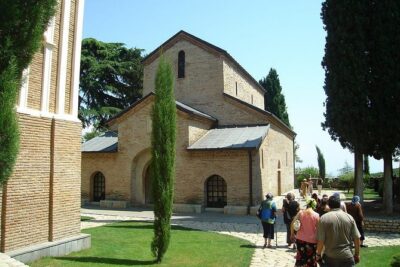
Kakheti;City of Love Sighnaghi, Bodbe. KTW. Wine House Group tour
Read our review →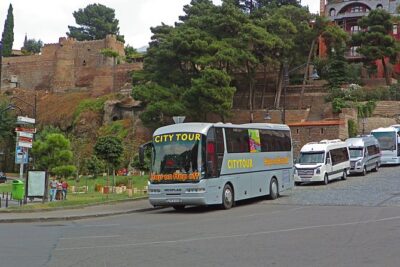
Mtskheta – Jvari. Full City Tour on Hop On Hop Off Bus
Read our review →
Day tour to Chronicles of Georgia, Gori city, Uplistsikhe cave
Read our review →
Tbilisi city tour PRIVATE excursion Airport and hotel pickup INCL
Read our review →
Tbilisi City Tour, Most Popular Tourists Destinations In The Capital Of Georgia
Read our review →
Browse the lists this tour appears in