
Reviewed · 1-DAY TOURS
Chiatura and Katskhi Pillar One Day Urbex Tour
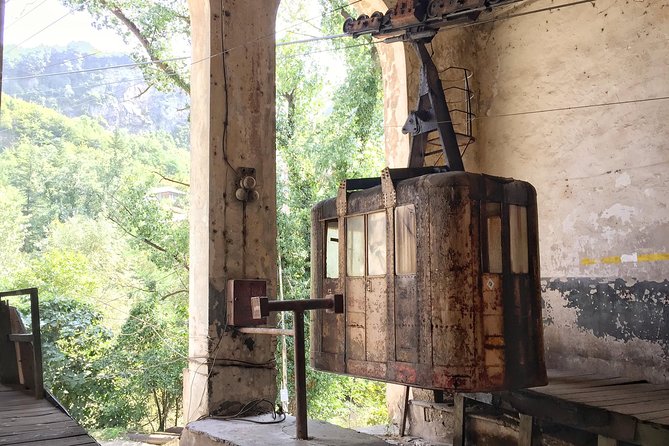
Chiatura’s old cable cars are the star here: battered Soviet machines crossing a river gorge, linking a former manganese-mining town with the hills above. Add the cliffside Katskhi Pillar and the ancient Mgvimevi Monastery, and you get a day far removed from Georgia’s usual wine roads and postcard churches.
I like the tour for two clear reasons. First, it takes you to a genuinely local part of western Georgia, not just the familiar highlights. Second, guides such as Aleksy and Alex bring useful cultural and industrial context, while a private group lets you set the pace. The tradeoff is the long road trip, roughly 2.5 hours each way, and some cable cars may be closed or under repair.
Key things to know before booking
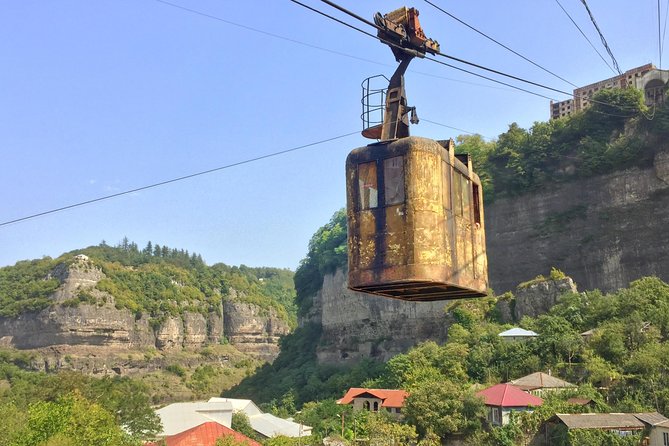
- Chiatura’s Soviet cable cars remain the main attraction, but you may not be able to ride every line.
- Katskhi Pillar is viewed from below, with a 45-minute stop at the limestone monolith.
- Mgvimevi Monastery adds Georgian religious art and architecture to an otherwise industrial day.
- A private upgrade gives your group more control, including hotel pickup and a more flexible pace.
- The drive takes about five hours in total, so this is a full-day outing rather than a quick side trip.
- Old cable cars and high viewpoints require a head for heights and are not suitable for visitors with mobility concerns.
Why Chiatura makes this day trip different
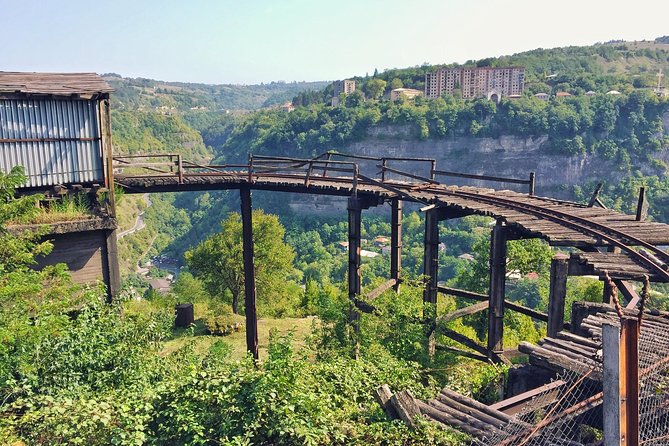
Chiatura is not a polished sightseeing town. Its appeal comes from the remains of a working industrial system built into the hills. The Qvirilia River cuts through the town, and old aerial cableways connect the lower streets with mining areas above.
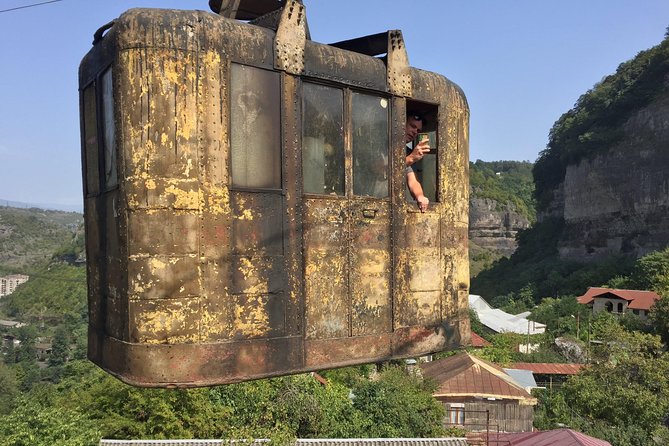
The system was built during the Soviet period and includes 10 passenger cars plus two cars used for manganese transport. The cable network covers more than 6 kilometers. Some stations still carry murals of Soviet heroes, giving the ride an unusual mix of public transport, engineering history, and political art.
You are not simply looking at abandoned machinery from a distance. Some cable cars still operate and serve as transport around the city. That said, the condition of the lines changes. A cableway may be closed for repair on the day of your visit, so you should treat the rides as an important possibility, not a guarantee.
The cars hold a maximum of four people. That small capacity matters. You may need to wait, and a private group cannot always travel together if more than four people are present. On the plus side, the limited size makes each ride feel more personal and keeps the experience from turning into a crowded attraction.
A few more things to do in Tbilisi worth a look
- Soviet past – Private day tour to Chiatura, Katskhi pillar and Chronicles
★ 5.0 · 29 reviews - Soviet Story – Private day trip to Chiatura, Stalin’s museum and Katskhi pillar
★ 4.5 · 15 reviews - Kutaisi:Chiatura Tour with Katskhi Pillar & Cable Car Experience
★ 5.0 · 95 reviews
The 2.5-hour drive from Tbilisi
This tour asks for a serious time commitment. You leave Tbilisi in the morning and return in the evening, with about 2.5 hours on the road in each direction. For some people, that sounds excessive for a single town and a pillar. For anyone interested in Soviet engineering, industrial archaeology, or lesser-seen Georgia, the distance is part of the bargain.
I would not choose this outing if you want a relaxed day close to Tbilisi. I would choose it if you have already seen the capital’s main sights and want something with a more unusual character.
The road time also makes a private booking more useful. Your group can ask questions, adjust the pace, and avoid waiting for unrelated passengers. Hotel pickup is offered for private tours, while the meeting point for other arrangements is clarified after booking. Bottled water is included, but lunch is not, so plan for that before setting out.
If you are prone to motion sickness or back problems, think carefully before booking. The long drive is clearly the main physical burden of the day.
Mgvimevi Monastery, a quiet opening stop
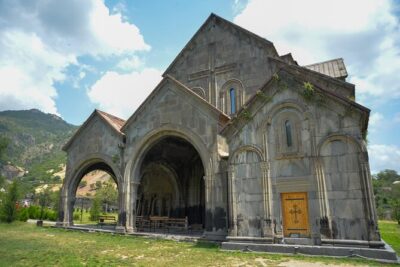
The first scheduled stop is Mgvimevi Monastery, a religious complex built in the 8th century. It sits against a cliff and includes a small church partly carved into the rock, along with a two-storey bell tower dating from the 12th to 14th centuries.
The church facades carry crosses and ornamental borders. Inside, the walls include mural paintings from the 8th century, with later work from the 16th century on the southern wall. One older fresco shows the nobleman Rati from the Racha region with his wife and his brother, Niania Kakhaberisdze.
This stop gives the day a needed change of pace. After the long drive, you begin with a place of worship rather than machinery and concrete. The setting also helps explain how closely Georgian religious sites are tied to rock formations and remote valleys.
A tunnel under the church was strengthened with arches. Two important objects once connected with the monastery, an engraved icon and a rare curved wooden door from the 11th century, are now held at the Georgian National Museum. You will not see those objects here, but the guide can place the site within Georgia’s wider cultural story.
You get about 45 minutes at Mgvimevi. That is enough for a focused visit, though not a long study of every architectural detail. Admission is free.
Katskhi Pillar and the story of Maxime
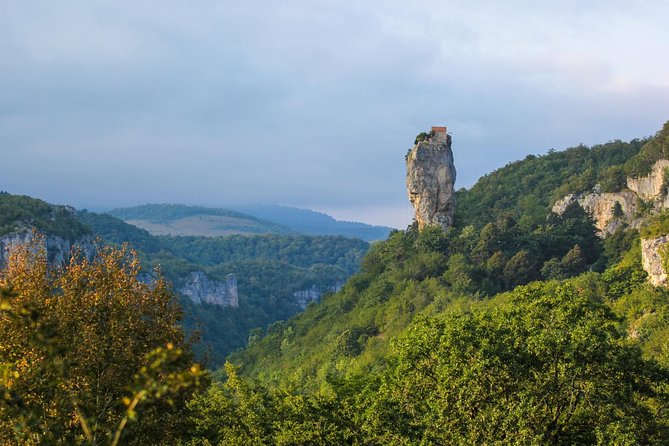
Katskhi Pillar is a natural limestone monolith near the village of Katskhi, close to Chiatura. It rises sharply from the surrounding countryside and has become one of western Georgia’s most recognizable sights.
The tour allows about 45 minutes here. The key point is that you visit the pillar and learn about its religious importance, including the monk Maxime, described as its sole resident. The stop is more about seeing the formation, understanding its place in Georgian faith, and taking in the setting than about climbing to the top.
That distinction matters. This is not a summit excursion. You should expect to view the pillar from the accessible visitor area rather than make a demanding ascent. The high, isolated position is what gives the site its force, even from below.
Katskhi also adds a touch of mystery to an otherwise industrial day. Mgvimevi shows Georgian religious architecture in a monastery complex. Katskhi presents devotion in a far more severe setting, where the rock itself is central to the story.
Weather can affect the schedule. The full experience is subject to favorable conditions, and outdoor viewpoints are less enjoyable in poor weather. Bring shoes suited to ordinary walking and be ready for a day that moves between religious sites, roads, and old transport stations.
Same base, a different sort of day:
- Day Trip to Kakheti Wine Region Including 9 Wine Tastings
★ 5.0 · 2,774 reviews - Highlights of Caucasus Mountains-Jinvali,Ananuri,Gudauri,Kazbegi(Group tour)
★ 5.0 · 2,682 reviews - Day Trip to Kazbegi and Gudauri
★ 5.0 · 2,009 reviews - Day Trip to Mtskheta Gori and Uplistsikhe
★ 5.0 · 1,801 reviews
Riding Chiatura’s old cableways
The cable cars are the heart of the tour. They cross the Qvirilia River gorge and connect the town with the former mining areas in the hills. The route gives you a high view of Chiatura, while the cars themselves show the age and design of Soviet public works.
Some stations are decorated with murals of Soviet heroes. These details are easy to miss if you only ride through, so listen closely to the guide and take time to look at the station walls. The setting is not dressed up for tourism. It remains part of the town’s daily infrastructure.
The cableways also reveal how the city grew around industry. The transport system was not built as a scenic attraction. It was a practical way to move workers and materials between the valley and the mines. That working purpose makes the ride more interesting than a standard sightseeing gondola.
You may find the cars cramped, old, and noisy. That is exactly why this stop suits people who enjoy industrial sites and Soviet architecture. If you prefer modern lifts, polished platforms, and safety systems designed for visitors, you may find the experience uncomfortable.
The capacity is four people per car. Some lines may be closed or under repair, and the tour cannot promise access to every cable route. A fear of heights or enclosed spaces is a serious reason to skip this outing. The day includes high viewpoints as well as old transport cabins.
Allow about three hours for the cableway portion. That time can include riding available lines, seeing stations, and understanding how the system fits into Chiatura. Since the private format allows more control, you can ask the guide to spend more time on the parts that interest you most.
Walking through central Chiatura
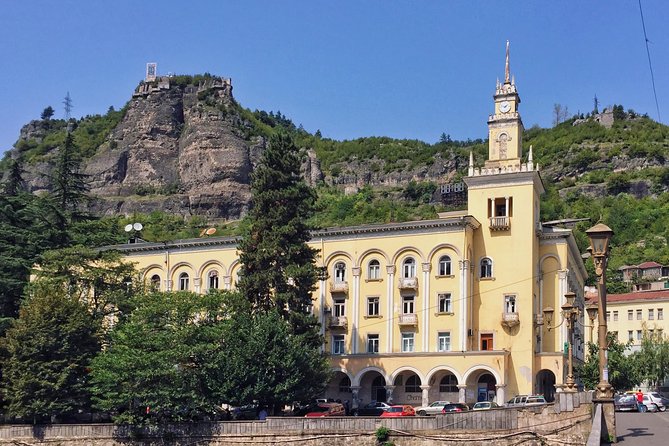
Chiatura is more than its cable cars. You also get about two hours to walk through the town center and look at its Soviet-era buildings and streets.
This is where the tour feels least like a standard excursion. The town’s appeal is not one grand monument. It is the combination of worn architecture, industrial infrastructure, river crossings, cable stations, and daily life in a place shaped by mining.
I like having two hours here because it prevents the outing from becoming a quick photo stop. You can pause, examine the buildings, and ask how Chiatura developed. The walk also gives you a break after the cable rides and lets you see the town at street level.
Keep your expectations realistic. This is urban exploration, not a restored historic district. Some areas may feel plain or weathered. That is part of the point, but it means the experience depends heavily on your interest in architecture and atmosphere.
The tour description also refers to the industrial towns of Chiatura and Zestaponi, though the detailed stops center on Mgvimevi, Katskhi, and Chiatura. If seeing Zestaponi itself is essential to you, confirm the exact route with the operator before booking.
What the private format changes
The experience is offered as a private tour, and hotel pickup is available for private bookings. That makes a practical difference on a 12-hour day. You do not have to match your walking speed or photo stops to a larger bus group.
The small-group format also suits the cable cars, which hold only four people. Guide attention is another strong point. Aleksy is specifically praised for making the day flexible and providing cultural and historical information, while Alex is noted for precise explanations of the places visited.
The wording around group discounts and small groups suggests that different booking arrangements may be possible, so check the final format when reserving. In all cases, confirm the pickup time and location in advance. The operator contacts you to clarify where and when you will be collected.
Children must be accompanied by an adult. Most people can take part, but the tour is not suited to visitors with mobility issues. You should also be comfortable with a long vehicle journey, uneven walking conditions, old cable cars, and high viewpoints.
Is $123 a fair price?
At $123 per person, this is not the cheapest day trip from Tbilisi. The value depends on what you want from your Georgia visit.
You are paying for a full day, an English-speaking local guide, bottled water, transport coordination, and access to places that are difficult to combine independently in one day. The guide’s role is especially important here because Chiatura’s cable system and Soviet-era sites make more sense with context.
The price is easier to justify for a private group that values flexibility. If three or four people share the cost, you gain hotel pickup, a personal pace, and direct attention without paying for several separate excursions.
Lunch is not included. Set aside time and money for food, and ask the guide how the day is arranged. The supplied information does not specify a restaurant or meal stop, so do not assume lunch is built into the schedule.
Free cancellation is available up to 24 hours before the start time. Changes or cancellations inside that window are not accepted for a refund. The operator confirms the booking at the time of reservation.
Who should book this tour?
You should consider it if you like:
- Soviet architecture and public engineering
- Industrial archaeology and old transport systems
- Quiet religious sites away from the main tourist circuit
- Long day trips with several different types of stops
- Flexible private touring with an English-speaking guide
- Places that feel lived-in rather than restored for visitors
You should think twice if you want a short transfer, a polished attraction, or a guaranteed ride on every cable line. You should also skip it if heights, enclosed cabins, long car journeys, or rough walking conditions are likely to spoil your day.
The tour is recommended by all listed participants and has a 4.9 rating from 14 reviews, but the small sample size is worth keeping in mind. The strongest pattern is clear: personal attention, guide quality, and the unusual nature of the destination are the main reasons to book.
Should you book the Chiatura and Katskhi Pillar tour?
Book it if you want to see a side of Georgia built around manganese mining, Soviet engineering, and remote religious places. The combination of Mgvimevi Monastery, Katskhi Pillar, and Chiatura’s cableways gives the day more variety than a single industrial stop.
I would choose the private version if possible, especially for a small group. You get hotel pickup, more control over the pace, and better use of the long day. Before paying, confirm which cable lines are operating, ask about the lunch plan, and make sure everyone in your group is comfortable with heights.
If that checklist works for you, this is one of the more unusual day trips from Tbilisi. If it does not, stay closer to the capital and choose a shorter outing.
FAQ
How long does the Chiatura and Katskhi Pillar tour last?
The tour lasts approximately 12 hours, including the journey between Tbilisi and western Georgia.
How long is the drive from Tbilisi?
The drive takes around 2.5 hours each way, making the total road time about five hours.
Is hotel pickup included?
Hotel pickup is available for private tours. The operator contacts you to confirm the pickup time and location.
Is lunch included?
No. Lunch is not included in the tour price.
Is the tour offered in English?
Yes. The experience is offered in English and includes a local guide.
Can I ride every cable car in Chiatura?
Not necessarily. Some cable lines may be closed or under repair, so visiting every line is not guaranteed.
How many people fit in a cable car?
Each cable car has a maximum capacity of four people.
Is the tour suitable for people afraid of heights?
No. The tour includes old cable cars and high viewpoints, so it is not suitable for people with a fear of heights or enclosed spaces.
Can children join the tour?
Yes, but children must be accompanied by an adult.
Just added in Tbilisi
- 8-Day Trekking Group Tour in Svaneti★ 5.0 · 21 reviews
- Private five days tour to Svaneti-Mestia, Ushguli, Becho,Chalaadi★ 5.0 · 21 reviews
- Join a Local for a Market Tour, Cooking Class and Meal in her Tbilisi Home★ 5.0 · 15 reviews
- Soviet Story – Private day trip to Chiatura, Stalin’s museum and Katskhi pillar★ 4.5 · 15 reviews
- Full Day Tbilisi City Tour with Wine Tasting & Cable Car Ride★ 5.0 · 18 reviews
- Tbilisi Walking Tour Including Cable Car and Wine Tasting★ 5.0 · 16 reviews
- Martvili Canyon & Prometheus Caves Private Day Tour from Tbilisi★ 5.0 · 25 reviews
- Tbilisi to Batumi, or vice versa – Private Transfer★ 5.0 · 27 reviews
1-Day Tours, compared.
Day Trip to Kakheti Wine Region Including 9 Wine Tastings
Read our review →

KAZBEGI GUDAURI ANANURI One day group tour From Tbilisi!
Read our review →
1 Day Private Armenia: UNESCO, Soviet & Curated Family Lunch
Read our review →Browse the lists this tour appears in