
Reviewed · TOURS IN TBILISI
Brutal Tbilisi: Urban exploration and untold stories
Tbilisi’s most revealing buildings are often far from the old town’s balconies and sulfur baths. This four-hour tour takes you to Soviet-era monuments, abandoned civic spaces, refugee housing, and dramatic concrete apartment blocks, showing how architecture records Georgia’s difficult modern story.
I like the mix of big architectural landmarks and ordinary places where people still live. I also like the personal scale: the tour is advertised for small groups, and guides such as Alex, Aleksi, Khato, and Khatuna are known for explaining both design and history in clear, lively English.
The main consideration is physical comfort. You will ride between sites, but you will also walk, climb, cross bridges, and visit rough or abandoned spaces. The standard group size information is slightly inconsistent, with a small-group maximum of six promoted in the highlights and a maximum of 14 listed in the general details.
Key points to know before booking
- The Ministry of Highways sets the tone: This famous concrete structure offers an immediate lesson in Soviet Brutalism.
- The route goes well beyond architecture: You learn about Soviet planning, post-Soviet change, displaced communities, and daily life in Tbilisi.
- Nutsubidze Skybridge is the visual highlight: Walk across elevated bridges between apartment towers, around 70 meters above the ground.
- The former archaeology museum adds an eerie edge: Its abandoned rooms bring a different mood from the monumental sites.
- The guide makes a major difference: Alex, Aleksi, Khato, Khatuna, and other local guides are praised for history, patience, humor, and flexibility.
- The $75 price buys access and context: It is good value if you want transport, several distant sites, and a human explanation of places that are hard to understand alone.
Why Brutal Tbilisi reveals a different city
Most first visits to Tbilisi focus on the old town, Narikala Fortress, churches, courtyards, and the riverfront. Those places deserve your time, but they show only one layer of the capital.
This tour shifts your attention to the twentieth and twenty-first centuries. Concrete ministries, university districts, elevated walkways, abandoned institutions, and apartment blocks tell you how Tbilisi changed under Soviet rule and how those buildings were later reused.
The word Brutal in the title refers to Brutalism, a style known for exposed concrete, strong geometric forms, heavy mass, and a practical approach to structure. The buildings here are not simply cold Soviet blocks. Some are bold and inventive. Others are worn, adapted, or tied to painful events.
That human side is what gives the outing its value. At former student dormitories, you learn that buildings once linked with education and youth now house people displaced from Abkhazia. Architecture becomes a record of political change, forced movement, and survival.
You also get a useful contrast with the polished parts of Tbilisi. The tour does not pretend that every building is beautiful or every stop is comfortable. Instead, it asks you to look carefully at a city that is still using, repairing, and reinterpreting its Soviet inheritance.
Other trips people book in Tbilisi:
- Day Trip to Kakheti Wine Region Including 9 Wine Tastings
★ 5.0 · 2,774 reviews - Highlights of Caucasus Mountains-Jinvali,Ananuri,Gudauri,Kazbegi(Group tour)
★ 5.0 · 2,682 reviews - Day Trip to Kazbegi and Gudauri
★ 5.0 · 2,009 reviews
Starting at the Ministry of Highways
The meeting point is the Giant Bicycle monument at Rose Revolution Square. From there, the route heads toward the former Ministry of Highways of the Georgian SSR, now associated with the Bank of Georgia building.
Allow about 30 minutes here. The structure is one of the clearest examples of Tbilisi’s bold Soviet modernism. Its stacked concrete forms create a striking silhouette, while the repeating blocks and sharp angles show how a government building could become a piece of monumental design.
Your guide can help you read the building rather than simply photograph it. Look at the way the blocks overlap, how the mass seems to balance, and how the structure appears both heavy and surprisingly open. It was designed for practical office use, yet it has the drama of a sculpture.
This is a good first stop because it gives you a visual vocabulary for the rest of the day. Once you understand the use of concrete, repeated shapes, elevated sections, and large public forms, later sites become easier to interpret.
The drawback is that the visit is fairly brief. You should expect an exterior-focused stop rather than a full museum visit. Bring a camera, but pay attention to the guide’s explanation, since the design makes more sense once you know what you are seeing.
The Chronicles of Georgia on the hill
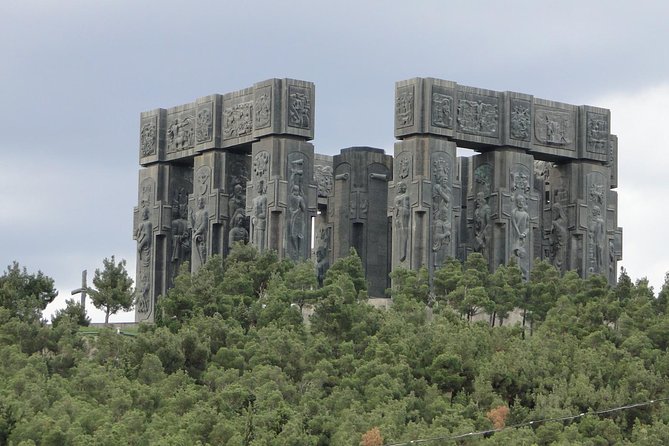
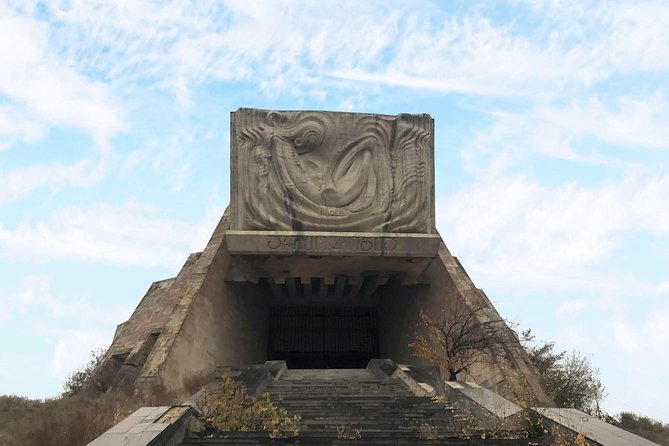
The Chronicles of Georgia, also called the Memorial History of Georgia, is the tour’s grandest monument. It rises on a hill overlooking Tbilisi and uses massive stone columns carved with scenes from Georgian history and religious tradition.
The planned visit lasts about 45 minutes. That gives you time to study the reliefs and take in the broad view. The columns refer to major episodes in Georgia’s past, the formation of the Georgian state, Christian traditions, rulers, and national legends.
This stop is not Brutalist in the same way as the Ministry of Highways. It belongs to a monumental style that uses scale and stone to shape a national story. That difference is useful. The tour is not a narrow procession of concrete buildings. It also examines how Georgia presents its identity through public art.
The hilltop setting adds to the experience. You can look across parts of Tbilisi and see how the city spreads beyond the historic center. The monument feels removed from the busy streets, which gives you space to think about the relationship between memory, power, and place.
Wear shoes with a steady grip. The tour requires a moderate level of fitness, and the site includes walking on open ground and uneven surfaces. The monument is also exposed to the weather, so check the forecast before dressing.
The former archaeology museum and its uneasy atmosphere
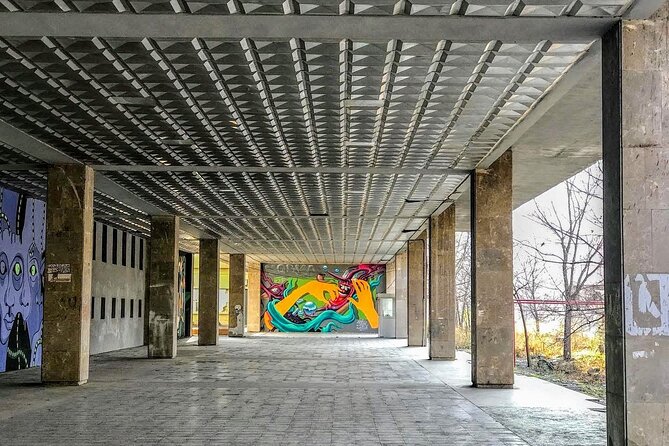
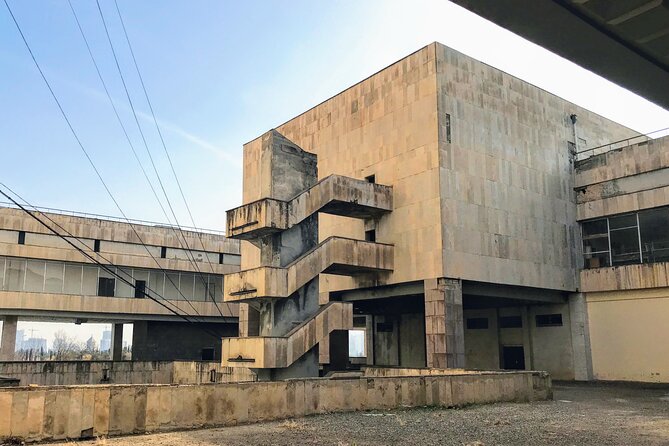
The former archaeology museum is one of the more unusual stops. The building was once an important cultural institution, but it is now abandoned. You get around 30 minutes to explore its architecture and absorb its worn, almost eerie atmosphere.
This part of the tour works because it breaks from the clean lines of formal monuments. Here, age and neglect are part of what you are seeing. Empty rooms, grand architectural elements, and signs of abandonment create questions about what happened to the institution and why the building was left behind.
Your guide is especially important at this stop. Without context, an abandoned building can become little more than a photo backdrop. With an explanation of its former role and place in Tbilisi’s story, the museum becomes a way to consider how public institutions rise, decline, and disappear.
This is also the point where you should be realistic about comfort and access. The supplied information describes it as a former, abandoned museum, not as a polished attraction. Conditions may feel rough, and the tour is not designed as a family-centered activity for young children. Adults interested in urban exploration will get the most from it.
Several visitors have singled out this stop as a favorite, which makes sense. It has surprise, mood, and a sense of discovery that the more famous monuments cannot quite match.
Same base, a different sort of day:
- Day Trip to Mtskheta Gori and Uplistsikhe
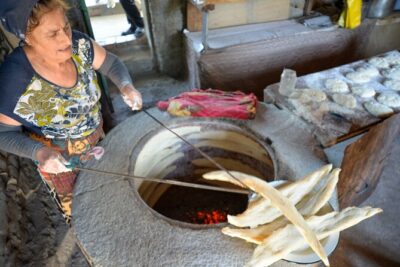
★ 5.0 · 1,801 reviews - Tbilisi Walking Tour Including Cable Car and Traditional Bakery
★ 5.0 · 1,310 reviews - Day Trip to Armenia Including Homemade Lunch
★ 5.0 · 1,162 reviews - Kakheti Wine Region: Signagi and Bodbe Tour with 10 Wine Tastings
★ 5.0 · 1,019 reviews
Maglivi Bridge, student housing, and displaced communities
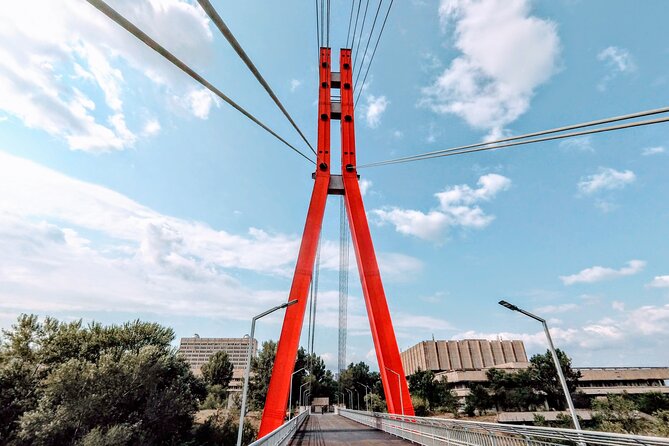
The Maglivi Bridge section adds social context to the architectural tour. You visit former student dormitories that now provide homes for refugees and displaced people. These buildings are not just examples of Soviet planning. They remain part of the city’s present.
This stop helps you avoid a common mistake when looking at Soviet architecture. It is easy to focus on shapes and materials while forgetting the people who live with the results. Here, the old dormitories show how a building can change purpose as political conditions change.
The route also includes the old cable car in the university district. It once represented progress and modern city planning. Today, it carries the feeling of another era, a reminder of how quickly infrastructure can lose its original role while remaining part of local memory.
The visit lasts about 30 minutes. Your guide may discuss the architecture, but also the events that shaped the lives of people now connected with these buildings. Guides are praised for treating this subject with care, which matters. Displacement is not a decorative detail in the story of Tbilisi.
This section may appeal less to someone seeking only dramatic photographs. It is strongest for you if you want to understand the city as a lived place, not a collection of unusual structures.
Crossing the Nutsubidze Skybridge
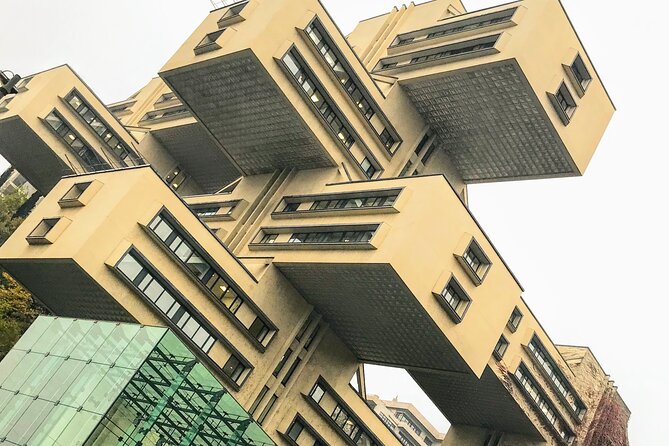
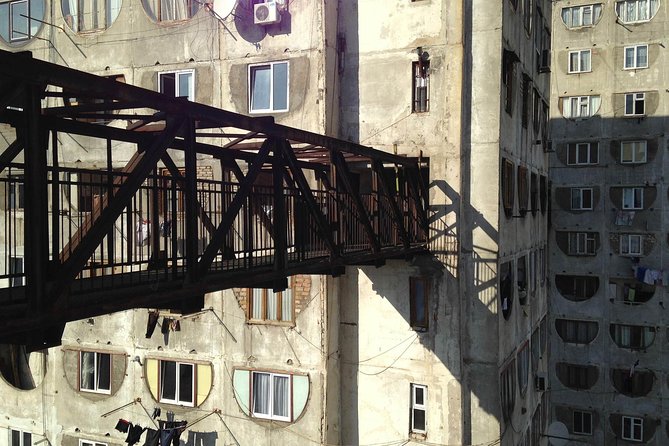
The Nutsubidze Skybridge is likely to be the tour’s most memorable stop. Twin residential towers are linked by elevated bridges, allowing residents to move between buildings without descending to street level. The bridges sit about 70 meters above the ground.
You have about 45 minutes here. That is enough time to look at the towers, cross the walkways, and take photographs from a very different angle. The views across Tbilisi are a major part of the appeal, but the design itself is just as interesting.
The skybridge shows how Soviet architects tried to solve practical problems through ambitious planning. Instead of treating apartment buildings as separate vertical blocks, the connected towers create a small elevated network. It is a bold idea, even if the buildings now show their age.
One of the tour’s most unusual details is the chance to meet the lift operator, sometimes called the lift lady. Her presence gives the place a human touch that photographs cannot provide. The elevator is not simply a machine serving a landmark. It is part of the daily life of the building.
Be aware of the height. If you dislike exposed bridges or feel uneasy with elevated walkways, this may be the most demanding part of the route. For most architecture fans, though, it is the payoff: a strange, practical, photogenic piece of Tbilisi that is difficult to appreciate without local access and explanation.
What the guide adds to the four-hour route
The tour covers a lot of ground, so the guide is not an optional extra. You need someone to connect a government office, a national monument, a deserted museum, refugee housing, and an apartment bridge into one story.
The strongest guide comments describe people such as Alex, Aleksi, Khato, Khatuna, Iona, and Xato as warm, patient, and ready to answer questions. Several are praised for allowing extra time for photographs and adjusting the pace when needed. One guide even helped a group with retired parents, allowing them to sit out the archaeology museum while remaining part of the day.
The experience is not limited to architecture terms. Guides explain Georgian and Soviet history, modern life, social change, and the details of the buildings’ designers. That wider discussion is why the tour can appeal even if you are not an architecture specialist.
Communication may vary by guide. English is the tour language, and most feedback describes clear communication, but one account points to moments where questions were not fully understood. If a point matters to you, ask again in a different way or let the guide know you want more detail.
The vehicle also matters. This is not a four-hour walking tour. You ride between distant parts of Tbilisi, then walk at each location. Private tours include hotel pickup, while the standard meeting point is Rose Revolution Square.
Is $75 a fair price?
At $75 per person, this is more expensive than a basic city walking tour. The price makes more sense when you consider the distance between the sites, the vehicle, bottled water, an English-speaking local guide, and the time required to reach places outside the usual center.
You are also paying for interpretation. The Ministry of Highways and Nutsubidze Skybridge can be photographed independently if you know where to go, but the former archaeology museum, refugee housing, and social background are harder to understand without someone who knows the city.
The value is strongest for a first-time visitor who wants a focused introduction to Soviet and post-Soviet Tbilisi. It is less compelling if you already know the city well, have your own transport, and only want to photograph one or two buildings.
Group discounts may be available, and the experience is usually booked about 14 days ahead. Confirmation comes at booking, and you can cancel for a full refund up to 24 hours before the start time. Changes made later are not accepted.
Who should book this Tbilisi architecture tour?
You should book it if you like modern architecture, urban history, abandoned places, Soviet design, or stories about how cities adapt. It is also a good choice if you have already explored the old town and want a completely different view of the capital.
Photographers will find plenty to work with: stacked concrete, hilltop monuments, high walkways, old transport infrastructure, and wide city views. Bring spare phone storage and allow time for the guide’s explanations rather than rushing from one photo to the next.
The tour suits adults best. Children can attend with an adult, but the operator recommends family-friendly alternatives for younger children. A moderate fitness level is sensible because of the walking, bridges, uneven areas, and time spent outdoors.
I would not choose this as your only Tbilisi tour. It does not replace the old town, Georgian food, churches, or the city’s traditional courtyards. I would pair it with those experiences, using Brutal Tbilisi to understand the capital’s more recent and less polished chapters.
Should you book Brutal Tbilisi?
Book this tour if you want Tbilisi to make sense beyond its postcard center. The strongest parts are the combination of striking design and real social history, especially at the former archaeology museum, the refugee housing, and Nutsubidze Skybridge.
The main caution is that this is not a gentle sightseeing loop. Some places are worn, the schedule covers a lot of ground, and the quality of your experience depends partly on the guide assigned to your date. Still, the record of highly positive feedback and the repeated praise for Alex, Aleksi, Khato, and Khatuna make the $75 price reasonable for architecture fans and curious first-time visitors.
If your idea of a good day includes concrete towers, old elevators, Soviet planning, unexpected viewpoints, and stories that do not appear on the standard city route, this is a smart addition to your Tbilisi plans.
FAQ
How long does Brutal Tbilisi last?
The experience lasts approximately four hours.
What language is the tour offered in?
The tour is offered in English.
Where does the tour start?
It starts at the Giant Bicycle monument at Rose Revolution Square in Tbilisi.
Where does the tour end?
The activity ends back at the meeting point.
Is hotel pickup available?
Hotel pickup is available only for private tours.
What sites are included?
The route includes the former Ministry of Highways of the Georgian SSR, Chronicles of Georgia, the former archaeology museum, Maglivi Bridge and the university district, and Nutsubidze Skybridge.
How many people can join the tour?
The highlights describe a small group of up to six people, while the general information lists a maximum of 14 travelers. Confirm the group size when booking if this matters to you.
Can I cancel the tour?
You can cancel for a full refund if you cancel at least 24 hours before the start time. Cancellations or changes made less than 24 hours before the tour are not accepted.
Just added in Tbilisi
- 8-Day Trekking Group Tour in Svaneti★ 5.0 · 21 reviews
- Private five days tour to Svaneti-Mestia, Ushguli, Becho,Chalaadi★ 5.0 · 21 reviews
- Join a Local for a Market Tour, Cooking Class and Meal in her Tbilisi Home★ 5.0 · 15 reviews
- Chiatura and Katskhi Pillar One Day Urbex Tour★ 5.0 · 14 reviews
- Soviet Story – Private day trip to Chiatura, Stalin’s museum and Katskhi pillar★ 4.5 · 15 reviews
- Full Day Tbilisi City Tour with Wine Tasting & Cable Car Ride★ 5.0 · 18 reviews
- Tbilisi Walking Tour Including Cable Car and Wine Tasting★ 5.0 · 16 reviews
- Mtskheta – Jvari – Samtavro, the cradle of Georgian Christianity. (group tours)★ 4.5 · 24 reviews
Tours in Tbilisi, compared.
Day Trip to Kakheti Wine Region Including 9 Wine Tastings
Read our review →
Highlights of Caucasus Mountains-Jinvali,Ananuri,Gudauri,Kazbegi(Group tour)
Read our review →

Tbilisi Walking Tour Including Cable Car and Traditional Bakery
Read our review →

Kakheti Wine Region: Signagi and Bodbe Tour with 10 Wine Tastings
Read our review →
Mtskheta,Jvari,Bazaar,wine tasting,Chronicles of Georgia
Read our review →Browse the lists this tour appears in