Reviewed · TOURS
Concrete Giants Tour
Tbilisi’s most revealing sights are not all in the Old Town. This tour takes you into the city’s Soviet-era architecture, from monumental concrete sculpture to apartment blocks, mosaics, and buildings most visitors pass without a second look. The ride itself is part of the story: you travel in a vintage Soviet car, reportedly an orange Lada, with guide David.
I like two things right away. First, the tour connects buildings to real life, including Georgia’s difficult relationship with the Soviet Union and its powerful northern neighbor. Second, lunch is included, so the morning ends around a local meal rather than another hurried photo stop.
The main consideration is that the formal itinerary gives only 20 minutes at the Chronicles of Georgia, while the broader experience depends heavily on the guide and the day’s route. If you want a fixed list of famous landmarks, this may feel loose. If you enjoy conversation, unusual buildings, and a less polished side of Tbilisi, that flexibility is a strength.
Key points about the Concrete Giants Tour
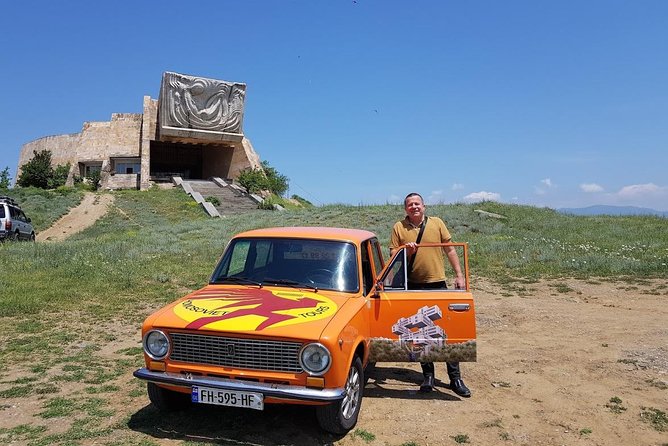
- Ride in a vintage Soviet car: The orange Lada adds character and turns transport into part of the experience.
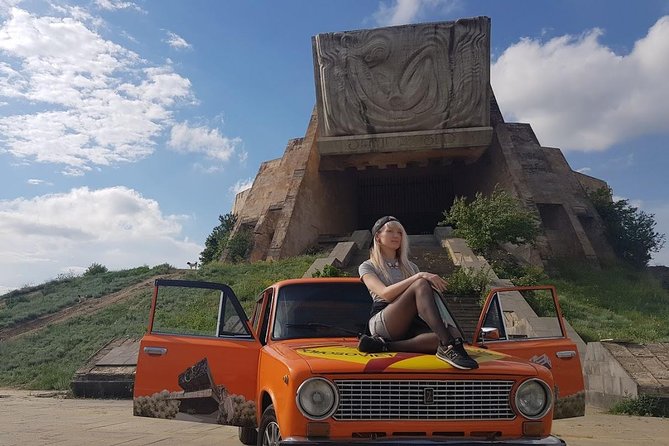
- See the Chronicles of Georgia: This monumental work, built between 1975 and 1985, is the tour’s major architectural stop.
- Look inside Soviet-era housing: The route can include apartment blocks and residential interiors, giving you a feel for ordinary urban life.
- Learn from David: His guiding style combines historical context, family experience, and discussion of present-day Georgia.
- Eat lunch during the tour: Food, snacks, and a vegetarian option by request are included.
- Keep the group manageable: The maximum group size is 20, though the vintage car format may feel more personal than a standard bus outing.
Why Soviet Tbilisi deserves a morning
Tbilisi is easy to approach as a city of balconies, churches, sulfur baths, and narrow lanes. Those sights matter, but they tell only part of the story. The Concrete Giants Tour shifts your attention to the twentieth century, when architecture became a public language for power, progress, ideology, and daily life.
Here, concrete is not just a building material. It can be monumental, severe, playful, or strangely graceful. Large public structures were meant to communicate confidence. Apartment blocks were built to house a changing population. Decorative mosaics and sculptural details gave ordinary public spaces a political and artistic message.
That makes this tour useful even if you are not an architecture specialist. David’s role is to explain how design connects to people. The strongest parts of the experience appear to come from his discussion of Soviet life, Georgia’s recent past, and the way older generations experienced the period.
The tour also looks beyond the Soviet years. You can expect conversation about the country’s current situation, the role of the Georgian Orthodox Church, displaced people, and the continuing effect of Georgia’s relationship with Russia. This is not simply a parade of large buildings. It is a way to understand why Tbilisi looks and feels the way it does.
Other trips people book in Tbilisi:
- Day Trip to Kakheti Wine Region Including 9 Wine Tastings
★ 5.0 · 2,774 reviews - Highlights of Caucasus Mountains-Jinvali,Ananuri,Gudauri,Kazbegi(Group tour)
★ 5.0 · 2,682 reviews - Day Trip to Kazbegi and Gudauri
★ 5.0 · 2,009 reviews
Meeting David at Rose Revolution Square
The tour begins at 11:00 a.m. at Rose Revolution Square, a central meeting point in Tbilisi. You return there at the end, which keeps the outing simple if you have an afternoon reservation or evening plans.
David is the guide most closely associated with the Concrete Giants experience. His approach is conversational and personal. He draws on family stories from the Soviet period and offers his own observations about Georgia, rather than delivering a memorized list of dates.
That matters on a tour like this. Concrete structures can be hard to read without context. A guide can point out how a building was meant to be seen, who used it, and how its meaning changed after the Soviet period. David’s style also leaves room for questions, which suits anyone who wants to discuss politics, architecture, urban planning, or daily life.
The maximum group size is 20 people. That is not a private tour, so you should not expect every stop to move at your own pace. Still, transport by private vehicle and the guide-led format should feel more direct than a large coach excursion.
The vintage Lada is part of the appeal
The vintage Soviet car is more than a novelty. It sets the mood before the first monument appears. Instead of treating the city as a series of disconnected stops, the ride places you inside the visual world the tour is explaining.
The orange Lada described in the tour experience has a strong personality. It is not the most modern or spacious form of transport, and that is worth keeping in mind. Anyone who prefers a roomy minibus, air conditioning, or a silent ride may find the vehicle less comfortable than standard sightseeing transport.
For me, the trade-off makes sense. The car fits the theme, and the smaller vehicle helps the outing feel distinct from a regular city tour. You are not just looking at Soviet-era objects from behind a coach window. You are moving through the city in a piece of Soviet-era design.
The vehicle is also useful for reaching parts of Tbilisi that do not fit neatly into an Old Town walking route. The experience is not presented as a long hike, and transport is included throughout the planned tour.
The Chronicles of Georgia: a dramatic concrete stop
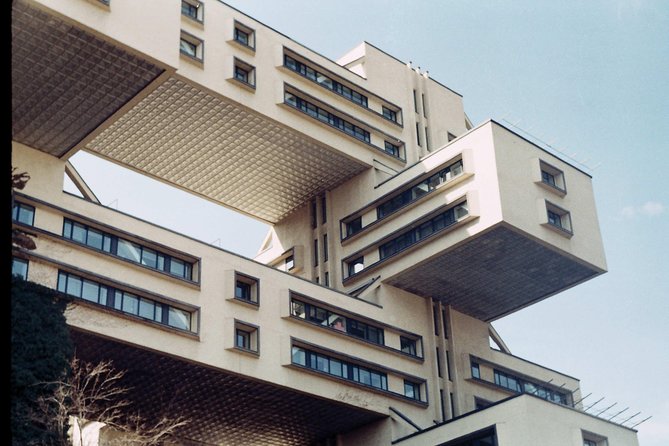
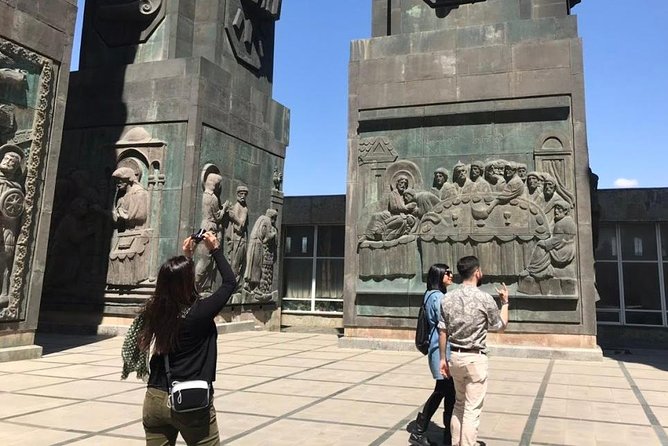
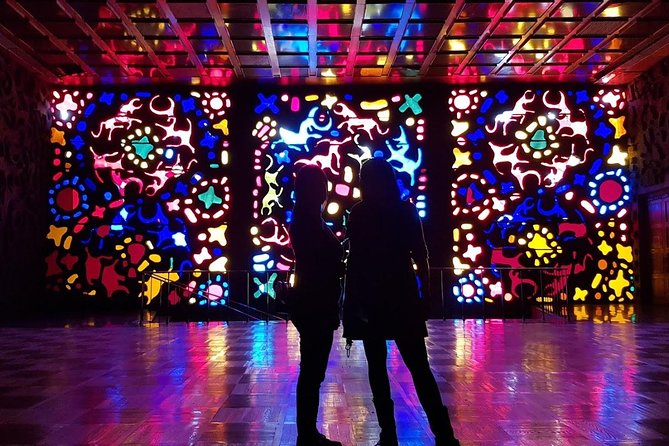
The clearest centerpiece is the Chronicles of Georgia, a monumental site dating from 1975 to 1985. The formal stop lasts about 20 minutes, with admission included.
The scale is the main event. Large sculptural forms rise above the city, giving the site a powerful sense of place. It is the kind of stop where a guide’s explanation helps you notice more than size and unusual shapes. The monument belongs to the late Soviet period, when grand public art could carry political and cultural messages at an enormous scale.
You should allow yourself a few minutes simply to look. Then pay attention to the details David points out. The site offers a strong setting for discussing Georgia’s identity, Soviet symbolism, and the way public monuments can remain important even after the political system that produced them has disappeared.
One advantage is that the Chronicles of Georgia is outside the usual Old Town circuit. The setting can feel quieter than the city’s best-known central sights, and the tour experience described here includes times when the monument area was nearly empty.
The drawback is the short scheduled visit. Twenty minutes is enough for an introduction and photographs, but not enough for a slow architectural study. If this monument is your main reason for booking, you may wish the schedule allowed more time. For the tour as a whole, though, it works as a major visual anchor.
Same base, a different sort of day:
- Day Trip to Mtskheta Gori and Uplistsikhe
★ 5.0 · 1,801 reviews - Tbilisi Walking Tour Including Cable Car and Traditional Bakery
★ 5.0 · 1,310 reviews - Day Trip to Armenia Including Homemade Lunch
★ 5.0 · 1,162 reviews - Kakheti Wine Region: Signagi and Bodbe Tour with 10 Wine Tastings
★ 5.0 · 1,019 reviews
Apartment blocks, mosaics, and ordinary Soviet life
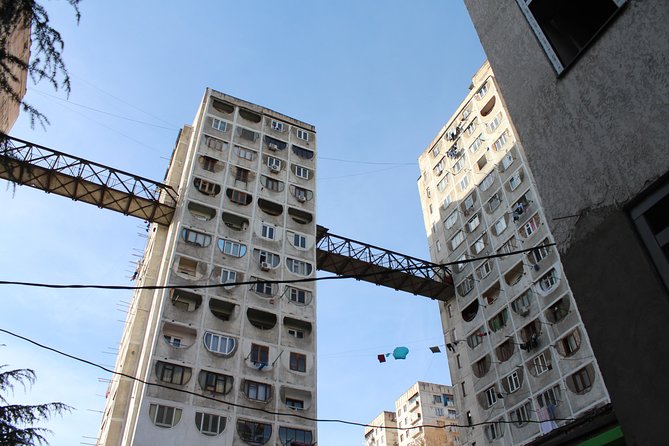
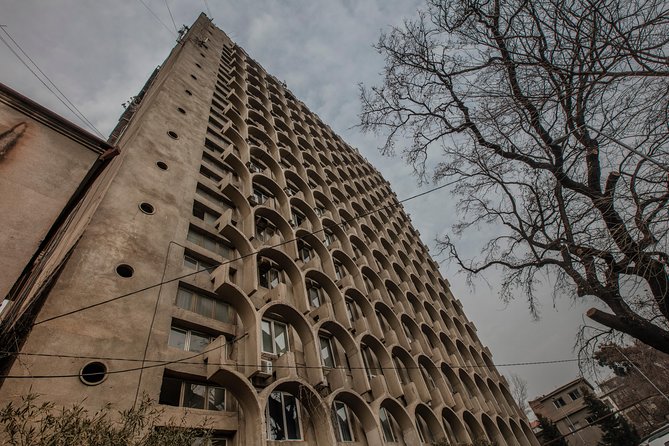
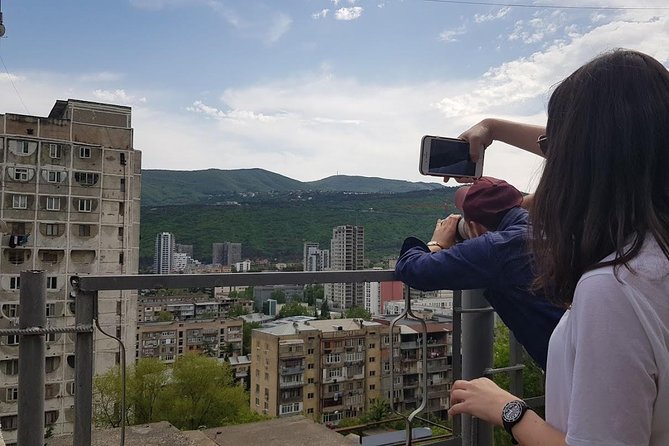
The tour’s most unusual feature is the chance to see beyond monumental public architecture. The route can include Soviet apartment buildings, residential areas, and interiors of typical apartments. That shift from giant public sculpture to ordinary housing is important.
A monument tells you what a government wanted to project. An apartment block tells you more about how people were expected to live. Shared layouts, repeated designs, practical construction, and later changes reveal the difference between official ideals and daily routines.
You may also encounter Soviet mosaics and other decorative details scattered through the city. These works are easy to miss if you are moving between major attractions. With David pointing them out, a blank wall or aging public building becomes part of the city’s visual record.
I especially like this part of the route because it avoids the usual postcard version of Tbilisi. You are not only seeing restored facades or carefully presented monuments. You are looking at buildings that still carry the marks of use, neglect, adaptation, and time.
The exact route can vary, and detouring is not included. That means you should not assume every possible Soviet site will be added on request. The tour has a planned structure, and any extra time or bespoke extension needs to be arranged separately.
The history is personal, not just political
The tour’s strongest subject is Georgia’s recent past. David explains the Soviet period through public buildings and family experience, which gives the discussion a human scale.
You can expect attention to Georgia’s relationship with the Soviet Union and its difficult relationship with Russia. The conversation may also touch on displaced people, the place of the Church in modern Georgian society, and the country’s current direction.
This subject matter is best approached with curiosity. The tour is not a neutral architecture lecture stripped of politics, nor is it a simple condemnation of the past. It aims to show how political systems leave marks on streets, homes, monuments, and family memories.
That makes the experience a good match for you if you want to understand modern Georgia beyond food, wine, and scenery. It is also a good choice for anyone interested in urban planning, public art, design, or the way ideology shapes cities.
You should not book it expecting a standard sightseeing script. The experience appears to work best when you ask questions and allow the guide to connect one subject to another. David is described as patient and generous with explanations, but the conversation can become more detailed than some people want from a short morning outing.
Lunch gives the tour a welcome local finish
Lunch is included, along with snacks. The meal is not an optional add-on, and it gives the tour a natural pause after the morning’s architecture and history.
The food experience can include Georgian dishes in a restaurant away from the main tourist circuit. That matters because a meal provides another way to understand the country. You get to sit down, talk, and consider the morning rather than rushing straight to the next attraction.
Vegetarian food is available, but you need to request it when booking. Alcohol is not included, though it can be purchased separately. Those details are small, but they are worth handling in advance so lunch goes smoothly.
Food quality is always more variable than a monument or a scheduled meeting point. Still, lunch adds real value to a $54.01 tour, especially when private transport, a guide, snacks, and admission to the Chronicles of Georgia are included.
Is $54.01 a fair price?
At $54.01 per person, this is not the cheapest way to spend a morning in Tbilisi. You can walk around central districts for very little money, and several major city sights cost less than a guided outing.
The value comes from access and interpretation. You are paying for a specialist route, private vehicle transport, a guide who can explain Soviet architecture and Georgian history, lunch, snacks, and admission to the main monument. You also save the time and effort of locating scattered concrete structures and working out how to reach them.
The price makes the most sense for a first visit when you want an organized introduction to a part of Tbilisi that is difficult to explore efficiently alone. It also works well for a return visit when you have already seen the Old Town and want something less familiar.
Group discounts are available, though the exact saving is not specified. Since the group can reach 20 people, check the final booking details if group size and price are important to you.
Timing, comfort, and practical details
The tour lasts about three to four hours and begins at 11:00 a.m. That leaves time for an afternoon museum, another neighborhood, or a relaxed meal after returning to Rose Revolution Square.
The advertised duration should be treated as an estimate. The tour experience can become more conversational, especially if you ask many questions. A longer discussion or additional sightseeing may be possible only as a separate arrangement, and detouring is not included.
Children must be accompanied by an adult. Service animals are allowed, and the meeting point is near public transportation. Most people can participate, but the vehicle and the architectural stops may not suit every mobility need. If you have specific access concerns, ask the operator before booking.
Confirmation is sent within 48 hours, subject to availability. Free cancellation is available if you cancel at least 24 hours before the start time. Changes or cancellations made later are not accepted for a refund.
Who will enjoy this tour most?
I would choose this tour if you have any interest in:
- Soviet architecture and urban design
- Monumental public art
- Georgia’s twentieth-century history
- Modern political and social life
- Local food away from the most obvious tourist stops
- Small-group sightseeing with plenty of conversation
- Unusual transport and less familiar parts of Tbilisi
It is also a good fit for solo visitors who dislike large coach tours. The private vehicle and direct guide contact make it easier to ask questions and shape the discussion around your interests.
I would be more cautious if your priority is a fast list of famous attractions. The tour focuses on one major monument and a broader set of architectural and residential sites. Some stops may be meaningful mainly because of the explanation, not because they are instantly photogenic.
You should also think about your interest in recent political history. The tour does not stay safely in the past. It connects Soviet design with Georgia today, so the conversation may include subjects that are serious, complicated, and open to discussion.
Should you book the Concrete Giants Tour?
Book it if you want to see Tbilisi through concrete, memory, and everyday life rather than only through its postcard sights. The combination of the vintage Lada, the Chronicles of Georgia, Soviet apartment buildings, mosaics, lunch, and David’s personal storytelling gives the morning a clear identity.
I would not book it solely for a monument checklist. The formal Chronicles of Georgia visit is short, and the route has a flexible, guide-led feel. But if you want to ask why Tbilisi looks the way it does, how Soviet ideas shaped the city, and what those buildings mean now, the $54.01 price is reasonable.
For architecture fans, history-minded visitors, and anyone who wants a more thoughtful side of Tbilisi, this is one of the city’s better specialty tours.
FAQ
Where does the Concrete Giants Tour begin?
It begins at Rose Revolution Square in Tbilisi at 11:00 a.m. The tour ends back at the same meeting point.
How long does the tour last?
The tour lasts approximately three to four hours.
Is lunch included?
Yes. Lunch and snacks are included. Alcoholic drinks are not included but are available to purchase.
Can I request a vegetarian meal?
Yes. A vegetarian option is available, but you should advise the tour provider when booking.
How many people can join the tour?
The maximum group size is 20 people.
What is the cancellation policy?
You can cancel for a full refund up to 24 hours before the experience starts. Cancellations or changes made less than 24 hours before the start time are not accepted for a refund.
Just added in Tbilisi
- Private Adorable City Tour of Tbilisi★ 5.0 · 3 reviews
- Tbilisi Airport to Gudauri, Bakuriani, Batumi, Tbilisi★ 5.0 · 3 reviews
- full day Kazbegi-Gudauri-jvari -from Tbilisi★ 5.0 · 6 reviews
- Old tbilisi walking tour & wine tasting★ 5.0 · 9 reviews
- Wine promenade in hospitable Tbilisi★ 5.0 · 17 reviews
- Vardzia. Lake Paravani, Khertvisi & Lomisa castle, Rabati★ 4.5 · 12 reviews
- Your unique photo session in Tblisi, Georgia★ 3.5 · 4 reviews
- Private Wine Tour In Kakheti Region with 7 Wines and Lunch★ 5.0 · 3 reviews
Tours, compared.
Highlights of Caucasus Mountains-Jinvali,Ananuri,Gudauri,Kazbegi(Group tour)
Read our review →
Tbilisi Walking Tour Including Cable Car and Traditional Bakery
Read our review →
Kakheti Wine Region: Signagi and Bodbe Tour with 10 Wine Tastings
Read our review →
Evening Walking & Talking Tour with Wine & Boat Ride
Read our review →
Kutaisi Canyons and Caves from Tbilisi Full Day Tour
Read our review →
Kazbegi and Gudauri Full Day Private Tour from Tbilisi
Read our review →
Diamond bridge and Dashbashi canyon day excursion from Tbilisi
Read our review →